AddThis

Bookmark and Share
Showing posts with label romance. Show all posts

Sunday, 8 March 2015

Nursing in the 1940's and 50's - Fetch Nurse Connie

I am thrilled to welcome Jean Fullerton to my blog today, to chat about her latest book and the way in which she researched and wrote the story. Known for her wonderful Powerpoint presentations about East End London life, Jean brings all her research and life experience in the NHS to her books about 1940's and 50's nursing.
Fetch Nurse Connie - Cover 18th Feb th Jan 2015..doc
Fetch Nurse Connie will be the fifth book in the East End Nurses series. How have circumstances in healthcare changed for Millie and Connie since the first book?

I purposely set Call Nurse Millie in the years after the end of the WW2 and before the introduction of the NHS in 1948 so people could see what the system of health care before the NHS was actually like. In the first book of the series Millie and Connie are employed by a local Nursing Association which is a voluntary organisation supported by subscriptions and fundraising rather than central funding. The second book All Change for Nurse Millie starts on 5th July 1948, the day the NHS came into being so I could show the changes to the new system and some of the problems it had from the very start.

As Connie is Millie’s closest friend and we meet her a great deal in Millie’s story it seemed natural to tell her story in Fetch Nurse Connie, during the same time period. Like Millie’s, Connie’s story starts on VE-Day 1945 when the old health system was still in place so we see Connie  not only grappling with the her patients illnesses but also the social conditions of the time.

Your books are impeccably researched. What are the two most valuable resources you use for discovering about medicine in the 1950's?
jean1 web picture
Thank you for saying so, Deborah. Unlike my previous 19th century books the East London Nurses’ Series is within living memory so I have the great privilege of being able to speak to nurses who worked in East London during that time.  However, my most valuable research resources are my collection of 1930s, 40s and 50s nursing and midwifery text books. These include books on child health, contraception, midwifery, nursing dictionaries and a 1945 doctor’s prescribing dictionary, all of which I have to hand all the time. The most valuable of these books is the 1947 edition of Merry and Irven’s District Nursing. This was the text book all trainee Queen’s Nurses’ would have bought. It has everything from clinical procedures to the various charitable institutions of the time like the Sick Children’s’ Fund and the Destitute Relief Board. It also sets out how fees were calculated and the proper administration of a local Nursing Association. It was totally invaluable in helping me breathe life into district nursing during that period. There is also a breakdown of the way the new Welfare State was to be implemented and how much the individuals had to contribute in to the National Insurance Scheme before they were entitled to receive benefits. I also think I must have every nurses biography of the 20th century and a few before.

Apart from Millie, who is your favourite character to write? Is he/she constructed around a real person from the past?
I actually enjoy writing her friend Connie, who is the heroine of the new book.  She has a very different story and other issues in her professional and personal life to cope with. Unlike Millie she is part of a large East End family, very like my own. After her fiancĂ©’s home-coming takes and unexpected turn Connie finds herself spending a great deal of time trying to put her heartache behind her and convince her mother and two sisters that there’s more to life than marriage and children.
I never consciously construct a character around anyone in particular but I hope Connie, like Millie, is a little bit like the nurse I strive to be.

What would surprise Connie and Millie most about nursing  today?
As a registered district nurse with 20 years’ experience working in East London I’m sad to say that today ‘care’ sometimes seems missing out of the equation. Not by nurses’ I might say. I teach nursing at a London University and can assure you the vast majority of the nurses I nurture through their 3 year’s training are kind and compassion and I’d be happy for them to nurse any of my nearest and dearest. Sadly, it’s the overburdened NHS full of targets, statistics and research that sometimes put unbearable pressure on them. In Millie and Connie’s day a nurse was responsible for all their patients’ needs. This included housework, personal care and nutrition along with the more obvious nursing tasks such as dressings and medication.  However, I’m sure she’d be amazed at the range of drugs now available – especially those to regular body systems such as diabetes, high blood-pressure and pain relief  plus being able to undertake such complex operation as open heart surgery and joint replacements.

How carefully do you plan your books? Do you have a strong outline, or do the characters know where they want to go?

Because I weave at least six patients’ stories through Connie’s over-arching story I plan my novels very carefully on a colour coded table. This allows me to space out Connie’s meeting with her patients, family and her ex-fiancĂ© Charlie. I can also see, for example of there are too many scenes with her family bunched together or if there’s too much space between her patients as we see their stories.
Of course it changes as I get to know the characters and ideas come to me but it gives me a place to start.

Thanks for asking me to drop by Deborah and for anyone who might want to read Connie’s story here’s a quick insight.
Fetch Nurse Connie.
Connie Byrne, a nurse in London's East End working alongside Millie Sullivan from Call Nurse Millie, is planning her wedding to Charlie Ross, set to take place as soon as he returns from the war. But when she meets him off the train at London Bridge, she finds that his homecoming isn't going to go according to plan.
Connie's busy professional life, and the larger-than-life patients in the district, offer a welcome distraction, but for how long?
Available from Orion Fiction on kindle, paperback and hardback on 4th June 2015
Click on the bookcover to pre-order.
Easter with Nurse Millie out 19th March
Fetch Nurse Connie out 4th June 2015.
All Change for Nurse Millie
Christmas with Nurse Millie e-novella.
Call Nurse Millie.

Tuesday, 24 February 2015

Award-winning author Charlotte Betts reveals her favourite English chateau

9780349404493

I have just finished Charlotte Betts' latest novel, Chateau on the Lake, which is yet another gripping romance from this award-winning novelist. I first came across Charlotte because she has written several books in one of my favourite periods - the seventeenth century, but for this novel we are invited to explore the 18th century and Revolutionary France.

After the death of her parents Madeleine Moreau must travel to France to search for the relatives she has heard of, but never met. The meeting proves disastrous and she is given shelter at Chateau Mirabelle, a breathtakingly beautiful castle which is home to the aristocrat Etienne D'Aubery. Of course there is a little competition for Madeleine's affections, with the handsome Jean Luc, and plenty of dark and sinister secrets in the Chateau's past.

Charlotte Betts recreates the detail of the period painstakingly, whilst still providing a pacy and satisfying romance. The sense of the course of the French revolution with all its horrors - the guillotine, the starving peasants, the mob violence - all these are faithfully depicted, whilst never losing the forward momentum of the plot. It is a hard thing to do, to juggle romance against such gritty realism, but Charlotte Betts does it seamlessly.

I wondered, after the attractions of France, which would be Charlotte's favourite English chateau, a place in which to spend a quiet afternoon - 

Corfe Castle is one of my favourite historical sites to visit. We often holiday in Dorset and I love the way the castle is the focal point of the village. It's always been sunny when I've visited and I like to sit quietly in the sunshine and allow the tourists' voices fade away. If I close my eyes and listen to the echoes of time it's almost possible to unlock the secrets of the past. I conjure up a vision of Lady Mary Bankes who, when her husband was away, led the defence of the castle during a six week siege by the Parliamentarians. What a wonderful novel that would make! Perhaps I shall write about that one day.
Charlotte 

National Trust


Corfe

With her talk of English Civil War sieges, I might just beat her to it. (Only joking of course!)
Find out more about Charlotte Betts on her website

Monday, 24 November 2014

A Saga Lover's Christmas Stocking - two books to hit the spot

amber keeper

I was lucky enough to attend the launch of Freda Lightfoot's new book, The Amber Keeper, and dived straight in to this gorgeously evocative tale of love and treachery in the Russian Revolution. Impeccably researched, the book  tells of how, in the 1960's, single mother Abbie tries to uncover the reason behind her mother's suicide. The trail leads her back through her grandmother's history as a governess in 1911. Being local to the Lake District I particularly enjoyed all the local references and descriptions of the English Lakes in the sixties, and thought they made a wonderful contrast to the snowy landscape of turn of the century Russia. The characters are well-developed, and the Countess Belinsky and her family provide Abbie's grandmother with much more than she bargained for in terms of danger and deception. Freda Lightfoot's well-written sagas are always a delight to read, and this is no exception, with themes of revenge and jealousy, hidden family secrets and enduring love.

christmas-fireside-short-stories-978144727683801

The second book I've been lucky enough to review this week is another treat for saga lovers: Christmas Fireside Stories. Our central heating boiler broke down last week, so we have been surviving by layering extra jumpers, lighting the log fire in the living room, and by carting electric fires from place to place in the bedrooms. So I was able to sit by my log-burner and read this selection of great stories and extracts - a perfect place to enjoy them. The six stories include a poignant re-telling of the 1914 truce during the first World War, expertly re-told by Margaret Dickinson. Although most people know the facts of this event, it was lovely to have it brought skilfully to life in this timely version. My favourite story was 'Christmas at Thalstead Halt' by Annie Murray, in which a shy railway worker finds that a broken down train brings him an unexpected Christmas gift. All the stories were well worth reading and enjoyable, fans of Diane Allen, Rita Bradshaw, Pam Weaver and Mary Wood will find they are well catered for in this anthology. If you like to look back to your childhood Christmases, to paper chains and coal fires, wartime rationing or clogs in the snow, this nostalgic collection hits the spot. The book contains anecdotes from the authors, recipes, and introductory extracts from their novels. AAh, all I need now is another mince pie!

Tuesday, 26 August 2014

The Attraction of the Highwayman Image - with Henriette Gyland


Both Henriette Gyland and I have new books out about  a female highwayman. Fascinated by finding this out, I invited Henri to come and enlighten us about her novel. Henri's novel is called The Highwayman's Daughter.  I asked her:

Did you base The Highwayman's Daughter on a particular highwayman?
This is a hard question to answer. Initially I would say “no” but the idea of the highwayman is firmly lodged in our collective consciousness that I probably did base it on a particular highwayman – or a conglomeration of several – without even realising it! In addition to that I wanted to work from the premise of an “ordinary decent criminal”, the otherwise upright character forced into a life of crime due to personal circumstances.

As a writer of romantic fiction it was important for me to maintain the myth and the romance of the highwayman. Of course, the reality was quite different – most highwaymen were ruthless thugs, and many were rapists and murderers too. Some even did it for kicks rather than necessity, like Lady Katherine Ferrers whose gutsiness I can’t help admiring despite her dubious reasons for taking to highway robbery (she was bored, apparently).

Yes, I agree. The myth and romance is what attracts readers to the idea. The reality may have been somewhat different! I had to think hard about how ruthless I wanted my female highwayman to be before I started writing, and I'm interested to know what you think makes a good female highway robber.

She has to be daring, but she can also be frightened. In the 18th century, who wouldn’t be scared of sustaining a wound from a victim determined to protect his (or her) property? Even if the wound itself wasn’t fatal, it could so easily turn septic, and our highway robber would die an agonising death. Then there was the risk of disclosure and being caught which would lead straight to the gallows, with only the rarest chance of a reprieve.

Like any other thief, our female highway robber would also have to be clever enough to dispose of stolen goods without drawing attention to herself and to blend in with everyday life.

From a purely writerly perspective, in order for her to be an effective female heroine, she has to have to have a Good Reason for committing her crimes. Even though she breaks the law and technically threatens innocent people into submission, she still needs a strong moral code.

Yes, I think you're right - the motivation is everything. But with such a compelling female protagonist,  how can the hero compete?!

Good question! To avoid the gutsy heroine taking over the story, in my opinion the only way the hero can compete is by having his own strengths. By that I don’t mean physical superiority, although he would likely have that, or an I-must-conquer-this-female attitude, but an inner strength which leaves him in no doubt about who he is and his place in society. However, if he belongs to the upper echelons, he should never pull rank over those less fortunate than himself, including the heroine.

He must be noble, honourable, and even when he makes mistakes, he must possess the courage to admit to these mistakes and do whatever it takes to right those wrongs. Can he break the law too? Sure, but like the heroine he must have a strong moral code.

I have just downloaded The Highwayman's Daughter and I'm looking forward to meeting your characters. I'm hoping that our two heroines don't meet on the road - or there could be a bit of a battle! Fortunately novelists are a bit more polite, and it's been a pleasure to have you here, Henriette.

You can find Henriette Gyland on her Website
On Twitter: @henrigyland or on Facebook

You can never have enough books about Highwaywomen!
You may also like:

Sunday, 10 February 2013

Chocolate and Romance from the 17th Century

Blog hop icon
This Giveaway has now ended and the winner is Susan Heim! Congratulations to Susan, and thank you to everyone who commented, or followed me on Facebook or the blog.


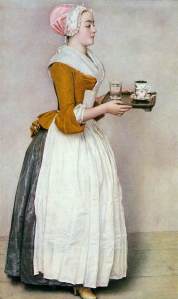
The Chocolate Girl
by Jean Etienne Liotard

I first wrote about this painting back in December last year in a post about maidservants, but I thought it was a great story for a Valentine's week post and worth highlighting again. I don't know if there is a novel based on this Cinderella-like tale, but it might make a good one. (No plans for it myself!)


The story behind the commissioning of this painting is a great romantic myth. The girl in the portrait, Anna Baltauf, worked as a maidservant in one of the Viennese chocolate shops which had become hugely popular during the 17th and18th centuries. She had little chance of good marriage as her father was too poor to give her a good dowry, however in the summer of 1745, a young Austrian nobleman - Prince Dietrichstein - came into the shop. He fell in love with the Chocolate Girl and asked her to marry him, despite objections from his family As a wedding present to his 'chocolate girl' he commissioned this portrait of his wife wearing the maid’s costume she was wearing when he first set eyes on her. Is this true? I guess we'll never really know.

Ella Appleby from my book The Gilded Lily would have loved this story. It was what she dreamed about for herself, that a prince might come and rescue her from her humdrum life. Sadie, her sister, would have gently told her to stop dreaming and to deliver the tray to the customer before the chocolate went cold.
More information about the story can be found here


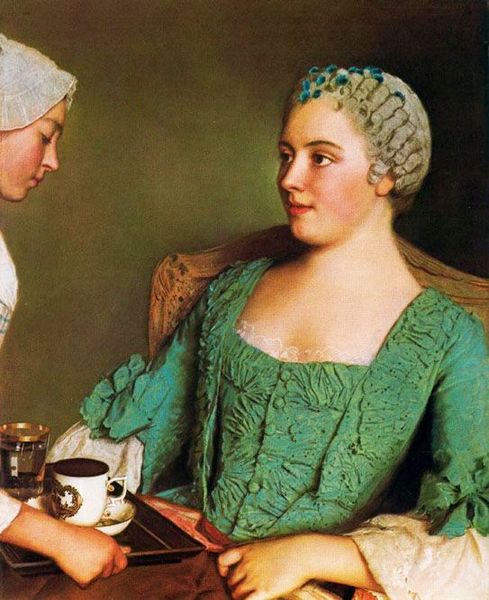
File:La prima colazione.jpgThe painting itself, formerly in Dresden, survived World War II and Allied bombs by being kept in a damp cellar in Konigstein Fortress  and brought back to Dresden after the Germans retreated from advancing Russian troops. Fortunately it seems none the worse, and is a wonderful portrait of costume and detail from the mid 18th century.

The same girl can be seen in one of Liotard's other works, 'The Breakfast.' 

I am offering two copies of THE GILDED LILY - one for the Hearts through History Blog Hop, and one for the League of British Artists Valentine Giveaway. (Click to take you there)
Both are International - wherever Book Depository delivers.

Please comment below to enter the Hearts Through History Giveaway and leave an email address. 
Two extra entries for following my blog, one extra entry if you 'like' my facebook page http://www.facebook.com/TheGildedLilyBook

Hop Participants - Hearts Through History 

Good luck everyone!

Wednesday, 6 February 2013

Thimbles - 17thCentury Engagement Rings


www.silive.com
Thinking about Valentine's Day ahead, I thought I'd share with you a snippet of research I discovered when I was writing my novel 'The Lady's Slipper' which features a woman who travels to the New World (ie America) in the 17th century.

I read that the Quakers and Puritans -some of the first settlers in the New World - did not like to wear jewellery, including wedding and engagement rings. This was because of their beliefs in living a simple and unostentatious life without embellishment or adornment - plain clothes in muted colours, and no unnecessary decoration.

17thC open-topped thimble www.treasurenet.com

Instead of the giving of a ring, it apparently became the custom for a betrothed couple to exchange a thimble. The thimble was something practical and was used by young women to sew household linens, and garments used as part of their dowry.

After the wedding, the man would cut off the cup of the thimble thus symbolizing that the young woman's sewing was over and the dowry was complete. The rim was then worn as a ring.
02 Le dé en argent de Fernande DESVIGNES
www.mercerieambulante.typepad.com
Some people dispute this claim, that thimbles were used as wedding rings, as a sort of 17th century urban myth. Click the link for the arguments against the idea.

Also, Quaker weddings at the time were not like the usual 17th century wedding in that they were agreed by the whole community of Quakers and subject to the feeling of the meeting as to whether the union was 'right.'

But being an old romantic, and loving a good story I like to think that young men would have used a romantic gesture like the giving of a thimble - so I prefer to believe this is true!

Wednesday, 3 October 2012

Alison Stuart talks about the Ghosts of the Past

Still to come at the end of this week, Desert Island Castaways Mary Metcalfe and Eliza Graham, whilst I am touring the blogosphere with THE GILDED LILY. 

Have a look at my post on Passages to the Past, or the interview and Giveaway on Let them Read Books - Last Day to enter!

Meanwhile, I took some time out of my schedule to Interview Alison Stuart about her new  romance GATHER THE BONES. I met Alison through the Hoydens and Firebrands blog where she invited me to join the other writers who are passionate about 17th century history.


Hi Alison, lovely to have you visit my blog.

Thanks for having me, Dee. Great questions!

What was the first story you wrote that you were proud to have written?

I have been writing stories probably since I could first hold a pen but my first “real” story was a school assignment in Form 3. We had an English teacher of the old fashioned kind (she wore a gown and tried desperately to drum grammar into our heads – on that count she failed). I can’t remember what the assignment entailed but it resulted in a ‘chapter story’ of a couple of thousand words called “The Stones of Chichen Itza” – my first foray into an archaeological mystery. I was inordinately proud of it (and the fact I had learned to use a Thesaurus in its creation). I bound it in a brown carboard cover illustrated with a Mayan head and I think it still lives in a trunk in the loft. Miss Robinson, who did not give praise easily, was fulsome in her review. I fell in love with writing.

Gather the Bones is set in the Great War. You and your husband both served in the Army Reserves, how did this impact on your understanding of the War?

My interest in military history probably stems from my father, who had been a career officer in the British Army. When I met my husband – we were both doing officer training in the Australian Army Reserve – I met my soul mate. Viewing the history of military campaigns with an understanding of the military mind brings a different perspective to the subject. When we lived in Singapore, to fill in those boring Sunday afternoons, we retraced the Fall of Singapore, visiting the various significant historical sites and reading the accounts. Our objective was to determine if the result would have been the same if Percival had held out for a little longer (we concluded - probably not).

D had been tracing his grandfather’s history. The family had known that he had been in the second wave at Gallipoli and had always assumed he had incurred his wound there. D discovered through the archives of the Australian War Memorial that he has survived Gallipoli and gone on to nearly two years in the trenches of the Somme. We found letters written to him while he was in hospital from his mates and now have a very clear picture of his military career. The result gave D a completely different perspective of his grandfather and he became very interested in visiting the battlefields of the Great War, which we did in 2005.

There is no doubt that the visit had a profound effect on us both. We were in Amiens for the Anzac Day commemorations and traced D’s grandfather’s war to the village of Pozieres. Standing on the hills looking down into the valley of the Somme and looking at it from the perspective of soldiers, not historians, gave the experience some clarity. Soldier to soldier, we had a great and abiding understanding of the foolish notions that turned the war into such a shambles.
Mercifully our own experience was one of a peace time army.

Tell me a little about where your love of history comes from.

Undoubtedly it came from my father (see answer above). He loved history and had a way of bringing it to life. He would take me to any “historical” film that was showing. As a child he would read us his favourite novels (not all of which may have been suitable for our tender ears) and I can still hear his beautiful, rich voice, transporting into imagined worlds of long, long ago. One of the books of his choice was DuMaurier’s The King’s General which instilled my passion and fascination for the English Civil War period.

What is it about the relationship between Helen and her cousin Paul that made them so fascinating to you?

Unfortunately Australia had not been discovered in the seventeenth century and I really wanted to create an Australian character. The Great War is so deeply instilled in the Australian psyche that writing Helen’s character gave me an opportunity to explore the experience of D’s family history and the many, many hours I have spent in reading and researching stories of the Australian experience of the First World War. Helen’s freedom is such a contrast to Paul’s repressive upbringing and his deep sense of honour and duty. I wanted to show them both as outsiders in the dying world of Edwardian English society that we see in Downton Abbey. Helen for being a mere colonial and Paul for being the poor relation and the wrong man.

 What is your greatest indulgence when writing?

Fry’s Chocolate Cream. I have discovered our local chocolate shop imports it from the UK so at vast expense I reward myself, every now and then, with a bar. It is one of those taste sensations from childhood that never goes away!

You work as a lawyer, do legal concerns make an appearance in your writing?

Not if I can help it! In fact it probably explains why I tend not to write contemporaries. As soon as I move into a contemporary I find myself writing about lawyers. My military background has had a far greater influence on my writing than my legal profession.

You have been involved for many years with the Romance Writers of Australia. What does this network mean to you?

I would never have been a writer without Romance Writers of Australia. It was only be sheer chance I came across them and from the moment I attended my very first conference, knowing NOTHING about writing in general and romance writing in particular, I knew I had found my tribe. I was fortunate to be President for a number of years and have just seen the organisation grow from nearly folding to what it is today. My dearest, dearest writing friends have come through this network. Only writers really understand other writers.

Have you ever seen a ghost?

No...and yes. Not face to face as it were but I have experienced what I can best describe as “sensations”. I have found myself in places or situations where I have felt cold and what I can only describe as a tight band around my chest. Only last weekend on a “ghost tour” this happened to me and later the guide described the place where it occurred as being a well documented haunted spot. This has happened to me often enough now to recognise that there are indeed more things in heaven and earth...

For more information and to watch the trailer go to http://www.alisonstuart.com/gather-the-bones.html


Thursday, 22 March 2012

The Apothecary's Daughter

The Apothecary's Daughter delights the senses.

I love the design of this book, which makes a change from headless women or vast expanses of flowing skirt. It is nicely designed inside too, with well-chosen period typography for the title pages and a good clear readable font.

You would not think London in the time of the plague would be good material for a romantic novel, but Charlotte Betts pulls it off superbly. The book tells the tale of Susannah, who, after the re-marriage of her father to the shallow and demanding Arabella, is forced to leave her erstwhile home to find marriage herself. As in all romances, the path of true love does not run smoothly, and in Charlotte Betts's novel, there are obstacles aplenty - not least her new husband, Henry Savage, who turns out to have quite a few secrets Susannah doesn't know about. The novel does not shirk from portraying the harsher realities of everyday life in the 17th century - slavery, the non-participation of women in society, and these aspects add depth to the story.


Unlike many other sketchily researched romances, this one really deserves the title "historical romance" as both aspects are in perfect balance.Vivid and engaging, the research is thoroughly done and succeeds in giving us an insight into this neglected period of English history, with all the smells of the apothecary's trade, the sage, the turpentine, the juniper. If you are looking for a cracking good story, and to be transported to another age, you really can't beat this.


Thursday, 26 January 2012

The Last Summer by Judith Kinghorn - sweeping historical romance


I read the paperback version of this which had a different cover showing a large country house, but I don't think that is out in shops yet. (I got it from Amazon Vine) But you can pre-order!

I read it on a train to London, and it took me two journeys to demolish it - a substantial novel then.

The Last Summer is set during the beginnings of World War I and tells the story of Clarissa, who loses her luxurious lifestyle and her home during the book.Impeccably written and well-researched this is an atmospheric and haunting read. It takes the reader from languorous summer days by the lake on a country estate to the horror of the trenches with equal aplomb.

The love story at its heart unfolds over sixteen years or so, so this is no flash in the pan romance but the real thing. Judith Kinghorn skilfully navigates our journey through love and loss, and despite the fact the reader knows that Clarissa and Tom must somehow find the inevitable happy ending the tension is nicely built through all the different episodes.Part of the story unfolds through letters which hold a secret not revealed until the end.

The social and historical background feels real. Clarissa's journey from society debutante to independent woman who wants to work for herself must be the journey many women took in this period and the book highlights this nicely. The back of the novel says it was "the end of a belle epoque" and Clarissa senses this before it is made real to her through the events in the story. People have likened this book to Downton Abbey, but it is not quite as cosy. Death and duty are here too, and the stifling repression of the moneyed classes.

This is a perfect balance of romance and grit, by a great new writer. Don't miss it.

Thursday, 9 June 2011

Mistress of My Fate by Hallie Rubenhold


When I pick up a novel written by a former historian I always wonder if it will turn out to be over-heavy on the factual detail, but I need not have worried with this rumbustuous adventure by Hallie Rubenhold.


Set in the late 18th century when society is arguably at its most decadent, the book begins the story of innocent 17 year old girl as she flees Melmouth House after the death of her 'sister', for which she has the blame. Penniless, she meets George Allenham who sets her up as his mistress, and gives her a new name. A new life begins, and the somewhat green Henrietta Lightfoot thinks she has found her one true love.


When he mysteriously disappears, she must track him down in order to survive, and the rest of the book concerns this search for her lover as she struggles from one dangerous location to the next. By the end of the book we have been thoroughly entertained in brothels and the seamier side of Covent Garden, but the central mystery remains thus leaving Henrietta Lightfoot with more work to do.

There are more volumes of the tale to come, all to be published by Doubleday, hence the few loose ends at the conclusion of the book. This was still a satisfying read though, and if I suspected that the book might be racy (subtitled as it was "The Confessions of Henrietta Lightfoot") I found there was nothing offensive about the descriptions of Ms Lightfoot's encounters with bawds, men with wandering hands, and other gentlemen of ill-repute. The historical detail is beautifully done.

What will determine your enjoyment of this novel is the "voice" of its heroine. It begins by adressing you as "My dear reader" and Henrietta continues to do this throughout. The effect of this is to distance the reader from the drama, as it is always being told as if it is a piece of gossip. This makes the voice very intimate, but also means the reader never quite enters Henrietta's head, so the tale is told in the same tone throughout, a bit like a visit to a favourite eccentic aunt. This will probably work well for some readers but not others. If you like Henrietta's style then you have a treat in store - two more volumes are scheduled.


I chose this to review from the Amazon "Vine" programme, and it has not yet been released - when it is, I'm sure it will appeal to readers looking for a well-researched lightweight historical romp.


Monday, 23 May 2011

The Somnambulist By Essie Fox


I must confess I have always had a liking for the Victorian and Edwardian periods, and when I was a costume designer I used to collect Victorian and Edwardian clothing. So I was somewhat surprised to find when I began writing my own novels that they do not slot into that time frame. My enthusiasm for the period remains undimmed though.


I was excited to hear about the Virtual Victorian's new novel The Somnambulist, and when it popped up as a selection for Amazon Vine I could not resist.

And what a gem it is. Bravo to Essie Fox, it is a long time since I have enjoyed a debut novel so much. It is literate, engaging and atmospheric. What's more, it has a plot that kept me turning the pages, and just when I thought I had discovered all the secrets of the book, there was one more twist in the tale.

Phoebe's journey to uncover her past takes her from the glitz and glamour of the East End Music Hall stage to the deliciously spooky Dinwood Court, surrounded by dark woods and deep water, and haunted by the death of the daughter of the house, Esther.

From the book:
"Life is rarely perfect." My father continued. "We all make mistakes. The thing is to forgive, and," he paused at the sound of some high muffled laughter, the splashing of water, "and never forget."


Novels are rarely perfect, but this one very nearly is. Beg, buy or borrow it, for a reading experience you will find hard to forget.

Here's the blurb:

'Some secrets are better left buried...'
When seventeen-year old Phoebe Turner visits Wilton's Music Hall to watch her Aunt Cissy performing on stage, she risks the wrath of her mother Maud who marches with the Hallelujah Army, campaigning for all London theatres to close. While there, Phoebe is drawn to a stranger, the enigmatic Nathaniel Samuels who heralds dramatic changes in the lives of all three women. When offered the position of companion to Nathaniel's reclusive wife, Phoebe leaves her life in London's East End for Dinwood Court in Herefordshire - a house that may well be haunted and which holds the darkest of truths. In a gloriously gothic debut, Essie Fox weaves a spellbinding tale of guilt and deception, regret and lost love.
Every heart holds a secret...