AddThis

Bookmark and Share
Showing posts with label review. Show all posts

Tuesday, 24 February 2015

Award-winning author Charlotte Betts reveals her favourite English chateau

9780349404493

I have just finished Charlotte Betts' latest novel, Chateau on the Lake, which is yet another gripping romance from this award-winning novelist. I first came across Charlotte because she has written several books in one of my favourite periods - the seventeenth century, but for this novel we are invited to explore the 18th century and Revolutionary France.

After the death of her parents Madeleine Moreau must travel to France to search for the relatives she has heard of, but never met. The meeting proves disastrous and she is given shelter at Chateau Mirabelle, a breathtakingly beautiful castle which is home to the aristocrat Etienne D'Aubery. Of course there is a little competition for Madeleine's affections, with the handsome Jean Luc, and plenty of dark and sinister secrets in the Chateau's past.

Charlotte Betts recreates the detail of the period painstakingly, whilst still providing a pacy and satisfying romance. The sense of the course of the French revolution with all its horrors - the guillotine, the starving peasants, the mob violence - all these are faithfully depicted, whilst never losing the forward momentum of the plot. It is a hard thing to do, to juggle romance against such gritty realism, but Charlotte Betts does it seamlessly.

I wondered, after the attractions of France, which would be Charlotte's favourite English chateau, a place in which to spend a quiet afternoon - 

Corfe Castle is one of my favourite historical sites to visit. We often holiday in Dorset and I love the way the castle is the focal point of the village. It's always been sunny when I've visited and I like to sit quietly in the sunshine and allow the tourists' voices fade away. If I close my eyes and listen to the echoes of time it's almost possible to unlock the secrets of the past. I conjure up a vision of Lady Mary Bankes who, when her husband was away, led the defence of the castle during a six week siege by the Parliamentarians. What a wonderful novel that would make! Perhaps I shall write about that one day.
Charlotte 

National Trust


Corfe

With her talk of English Civil War sieges, I might just beat her to it. (Only joking of course!)
Find out more about Charlotte Betts on her website

Wednesday, 18 February 2015

Red Rose, White Rose - Joanna Hickson researches Cecily Neville

My article on Red Rose White Rose by Joanna Hickson - Queen of the Castle. is featured in the Historical Novel Society Magazine this month. You can find it here on their website if you are a member of the HNS. If you like historical fiction, why not join? 
Red Rose White Rose

For those who are not members, here's a little insight...
The article describes how Joanna Hickson's research for this densely researched novel took her on a journey to visit a number of  castles where Cecily Neville lived, in order to build a picture and soak up the atmosphere. A heavy fall of snow made two particularly difficult. She tells us that Maxstoke Castle, a place where Cecily was under house arrest later in her life, was a classic four-square medieval moated castle, ‘a small jewel as opposed to a rambling fortress.’ Joanna explained, ‘The gates are still fortified with the iron-cladding installed by Cecily Neville's brother-in-law, Humphrey, 1st Duke of Buckingham and bear his cypher.' Here is Joanna's picture of that snowy day - there was no room for it in the article.
KONICA MINOLTA DIGITAL CAMERA
Maxstoke Castle
The other difficult castle to visit was apparently Ludlow. Looking round these castles in the snow, she says, 'gave me a very good impression of the dangers faced by the inhabitants of a freezing, draughty castle in winter.’
Ludlow
Ludlow Castle
According to Joanna, ‘Fotheringhay was Cecily Neville's favourite castle. 'It is where Richard III was born and, a hundred years later, Mary Queen of Scots was beheaded – two monarchs whose tragic histories may have caused it's subsequent decline into a mere footprint in the soil of the Northamptonshire landscape.’

Fotheringhay Castle

Cecily Neville is a fascinating character, and in Red Rose, White Rose we watch her mature against the background of constant in-fighting by her male relations. If you are a fan of the Wars of the Roses period, then this is a wonderful read. By the introduction of Cuthbert, Cecily's fictional illegitimate half-brother, we get an insight from a male as well as a female perspective into the feuding Plantagenets and their bloody battles for land and stronghold. Recommended.

Wednesday, 20 August 2014

The Advantages of a Book Blog Tour

I'm about to embark on another Virtual Tour with my new YA book, Shadow on the Highway 
(FREE on Kindle this week only! US  UK )

This will be the third blog tour I have done with my historical fiction books, and I'm really grateful to all the bloggers who are participating, and to Amy Bruno of HVFT who organises the schedule and generally keeps me on track. My first blog tour I organised myself, but it was enormously time-consuming, and now I hire someone to do the prep, which leaves me more time to concentrate on writing guest posts and promoting the tour.

I thought I would highlight the advantages of doing a blog tour, given that there are now so many blogs that readers are often overwhelmed by the sheer number, and end up not reading any at all.
The main point I want to let authors know, is that if you are looking for the blog tour to hard-sell your books, then you will probably be disappointed. 

Blog Tours build sales slowly as they are about relationships built over time with your readers, and about what is now called in the trade your 'author platform'. (Most people I know still think of a platform as a place to catch a train!) Virtual Tours are a chance not only to put your book out there online (where every body is, these days it seems), but to listen to the feedback from readers. Book Review bloggers read to a punishing schedule, often many books every month, and as such they are expert readers. They will soon spot any flaws in your book, and when several of them all say the same thing it is a chance for you, the writer, to address the problem in your writing.

I am excited to hear whether bloggers will notice a difference between my adult and teen titles, and what they will highlight as a great part of their reading experience.

For me as an an author the main advantages of a Book Blog Tour have been:
•    To get reviews and feedback from many different people, which tells me what the people who are attracted to my genre of fiction like and expect, and often quite clearly what they don't like!
•    To gain exposure on different blogs to their loyal followers, who are all people who read and are interested in books enough to read a Book Blog
•    That often, reviewers post up their reviews on Amazon, Goodreads and other online sites, leading to a higher profile for the author and more attention to older titles
•    A chance to chat to readers through comments on my guest posts and bring more life and vibrancy to the book blog hosting me

Whilst on the book tour it is tempting to tweet every review, highlight them all on facebook, and generally drive your regular readers crazy. Of course your hosts on the tour will expect you to promote their blog whilst you guest with them, but this can be a turn-off for your regular followers. The strategy that works best for me is to highlight each blog once, and then return to promote it after the blog tour has finished, so that way you can keep in touch with bloggers after the tour has ended. I do this, even if the blogger has left me an unfavourable review - after all, they committed their time to reading your book above other choices they may have had.

A Book Blog Tour is a wonderful way to increase your networking profile on Google and in search engines, and as a platform builder it is second to none. People are still reading my posts from my first blog tour which was three years ago, and I am returning to some book bloggers for the third time, proving that they are looking forward to sharing my latest book with their readers.

You will find the schedule for my tour if you click on the banner - Please join me to chat about my new release!

 photo 4080093a-0596-4942-9332-e4c00e9fb95c.png

Saturday, 22 March 2014

Powerful drama of a King's Execution - The Crimson Ribbon


Blurb:
Based on the real figure of the fascinating Elizabeth Poole, The Crimson Ribbon is the mesmerising story of two women's obsession, superstition and hope.

 May Day 1646. The Civil War is raging and what should be a rare moment of blessing for the town of Ely takes a brutal turn. Ruth Flowers is left with little choice but to flee the household of Oliver Cromwell, the only home she has ever known. On the road to London, Ruth sparks an uneasy alliance with a soldier, the battle-scarred and troubled Joseph. But when she reaches the city, it's in the Poole household that she finds refuge.

 Lizzie Poole, beautiful and charismatic, enthrals the vulnerable Ruth, who binds herself inextricably to Lizzie's world. But in these troubled times, Ruth is haunted by fears of her past catching up with her. And as Lizzie's radical ideas escalate, Ruth finds herself carried to the heart of the country's conflict, to the trial of a king.

I received this book for review from the Amazon Vine programme because I love the seventeenth century and it looked like my sort of book. I was not disappointed.
The story of Elizabeth Poole and her role as witness to the beheading of a King is brought masterfully to life in this gripping drama. Told through the eyes of Ruth Flowers who is on the run to escape a witch hunt, the book draws the reader gradually into the uneasy, fragile world of desperate people looking for an answer to the bloodshed of the English Civil Wars. Elizabeth Poole herself remains an enigma, shedding layers of shifting truths that make the reader unsure who or what she is. Is Elizabeth a sinner or a saint? Ruth's devotion to her, though not fully explained, is both her salvation and her downfall.

Although it only uses historical events as a kind of backdrop to the story I found the historical background to be well-researched and atmospheric.  But the strength of this novel is in the portayal of the ever-changing relationship between Ruth and Lizzie, and the writer's ability to take you fully into the mindset of a nation which can try a King for treason against his own country.

I look forward to more books from this debut novelist, Katherine Clements. For comparison you might like to try 'As Meat Loves Salt' by Maria McCann which tells of a similar obsessive relationship between two men, and is one of my favourite reads about this period.

Monday, 11 March 2013

Just What Kind of Mother are You? by Paula Daly


Just What Kind of Mother Are You?, Paula DalyI was on Twitter last week and I got a message from Alison Barrow at Transworld publishers asking if I'd like to read a debut novel set in the Lake District. Like most writers I have several jobs and a work-in-progress waiting, and I find I have to carve out time to read books I want to read, let alone review ones I'd never heard of. But I mailed Alison back to ask what genre, and she said 'psychological thriller'. I ummed and aaahed, but then thought - but it's the Lake District, the place I actually live. So I agreed to read it and I'm so glad I did because if I hadn't I would have missed a fabulous read.

So I was feeling overstretched, and overworked, and over-committed to all the different things going on in my life and opened the book to find it was about a mother who was also overstretched, overworked and over-committed. 

I so empathise with that feeeling.

Lisa is an exhausted mother of three. One day she takes her eye off the ball and completely forgets that her 13 year old daughter's friend was supposed to sleep over. That is until she finds out the girl has gone missing. This is the parent's second worst nightmare - someone else's child is missing and you are responsible. To make things worse, there is a rapist on the loose who is targeting young girls.

Lisa as the main character is empathic and interesting. Her job running a dog re-homing charity is one which is already a full-time occupation stretching well past working hours. Daly's depiction of Lisa's typical day will ring bells with many women who are trying to find the elusive work/home balance that probably only exists in the media and not in real life.


All the other characters possess the quirks and flaws that make for real human beings, and Paula Daly is adept at showing the subtle power games that go on between female friends and between husbands and wives. Told from several points of view, including that of the local female police officer who is attempting to solve the crime, this will satisfy lovers of crime fiction and would also make a great Book Club pick.

Once you have begun this well crafted book you will find it impossible to put it down until you finish it and find out the less-than-obvious fate of the missing girl. I found I was reading through meals, reading whilst others were watching TV, staying up late to finish it. 'Just What Kind of Mother are You?' is a well-plotted, believable thriller with plenty to make you think, and I for one can't wait for Paula Daly's next book.

And of course I shall be recommending it to my unsuspecting book group who meet in Windermere where the book is set. And indeed to anyone who asks me what to read next.

Wednesday, 8 August 2012

Men's Wars written by Women - Historical Fiction Reviews

Three of my favourite books this year feature male protagonists at war and a mostly male cast of characters - and interestingly all written by women. I'd recommend all three books to men and women, whatever you might think of their covers.

The first is "The Return of Captain John Emmett" by Elizabeth Speller. 
This novel tells the story of an execution during the Great War. Laurence Bartram, himself consumed by grief at the loss of his wife and young son, is approached by a friend's wife to unravel the mystery of why he committed suicide. His investigations lead to the gradual piecing-together of an incident in the war. Similar to a detective mystery, most of the action is told by reports from characters who were at the scene, very much like examining the scene of a crime. In the novel references are made to Agatha Christie and Poirot, and this book has all the intricate plotting of a who-dunnit, except better, and with a much more moving revelation of the true conditions of war. As a historical fiction writer I enjoyed the fact that long parts of the book were reportage - how often are we told to show not tell? But these re-tellings in the characters own voices were gripping, and show that the author had really done her research. The horrors of trench warfare and the subsequent abandonment of trauma casualties post-war were brought chillingly to life. In the afterword she tells us that she used the papers of W.H.R Rivers who treated psychiatric casualties of the war and Jonathan Shay's Achilles in Vietnam as sources.

Which brings me neatly to the second of my favourites - Madeline Miller's "Song of Achilles".
Of course this has won the Orange Prize for Fiction, but I was three-quarters through it when the prize was announced, so it did not influence my impressions of the book. Madeline Miller's version of the story of Achilles relies on building up an intimate picture of Achilles and Patroclus before the War at Troy actually starts. What I loved about this book from a writer's perspective was that the use of language was so lyrical. In a modern book it would be impossible to use terms such as 'the rosy gleam of his lip, the fevered green of his eyes' without it sounding ridiculous, yet in Miller's hands such language feels right. She has managed to make the book epic and Homerian. If the book has a weakness it is that the actual conflict (which in reality lasts ten years) takes a little too long to get going, but once it does the action is unputdownable. The early lyricism works just as well applied to battle, and the fact that some of the story is told from a dead man's point of view only increases its mystical effect.In this book we believe in the Gods, and in the terror of the Gods, and the power of human love.

The third of my favourites is "Honour and the Sword" by AL Berridge.

Of the three, this is the most swashbuckling of my choices. It is written as a series of  interviews or memoirs from  France during the time of the 30 years war and so includes a number of different voices put together by a fictional professor - Edward Morton. Sounds complicated? Perhaps, but it works brilliantly. Like a patchwork this method gradually builds up the picture of events from all the partisan points of view. Told in the first person present tense, some of it is written in very modern-sounding English but this has the effect of drawing the reader in. Mostly told from the point of view of Jacques the stable lad, and his erstwhile employer's son, an aristocrat called Andre de Roland, the slow development of the relationship between these two boys is what glues the book together. We watch them through the highs and lows of warfare, through heroism and despair as Andre de Roland seeks to avenge his parents death at the hands of the Spanish. This book has some excellent set-piece action scenes, with gripping sword fights, pistols and cannon.At the climax the action zips from person to person in a few lines - and this filmic technique like cutting from shot to shot, was breathtaking.


Three great pieces of historical fiction, I recommend them all.

You can read an interview with AL Berridge here about why she enjoys to write books more normally associated with a male readership.

Friday, 6 April 2012

The Language of Flowers - Vanessa Diffenbaugh

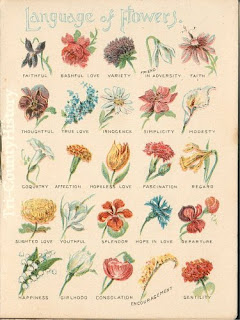
Common in the 19th century, the idea that flowers had symbolic meanings led people to convey their emotions through the gifts of the flowers they gave one another. Known as the art of "floriography", these symbolic bouquets became popular, and the posies were known as "tussie-mussies" in Victorian times. Today you can find more about the meanings of individual flowers from The Gardener

This Image comes from Joyce Tice's website


The Language of Flowers tells the story of Victoria, a homeless eighteen year old and her passion for the meanings of flowers.


Victoria has been brought up in foster care, and the only adult with whom she had a meaningful relationship was Elizabeth, the woman who first introduced her to the language of flowers. Because of a catastrophe for which Victoria herself is to blame (I won't spoil it for you) they have become estranged, and now Victoria is living rough. Desperate for work, she ends up in a florist's shop where her gifts with ascribing meaning to flowers are appreciated at last.

But life is not that simple, and Grant, an acquaintance from the past turns up.From there, things grow more complicated, and after they begin a relationship, Victoria becomes pregnant. Through a series of flashbacks the reader begins to understand what happened during Victoria's childhood to make her so distrustful of herself and others.

This book has been available for a while and has won awards. I imagine by now it is a book club classic, because I thoroughly enjoyed it. It is a well-written and absorbing read. You can watch Vanessa talk about writing her novel here

Here is my floral review, taken from the dictionary at the back of the novel.

 Lisianthus - appreciation
Rose, orange - fascination
Sweet Pea - delicate pleasures


Friday, 20 August 2010

"His Last Duchess" by Gabrielle Kimm - Review

This is the sort of book to take away with you on a wet weekend as it immediately conjures a sense of the hot sun of Renaissance Italy.

One of Gabrielle Kimm's strengths is that she is able to convey that heat and light to someone like me, sitting in Cumbria with the grey rain sheeting down outside. Her other strength is in describing the minutiae of life in a Tuscan estate, including a wonderful description of the kitchens, the intricacies of falconry, the manufacture of lime, and most of all the lost art of fresco painting.


'Flight of Aeneas from Troy', fresco painting by Girolamo Genga, 1507-1510, Pinacoteca Nazionale, Siena.

Impeccably researched, the history is woven fluidly into the plot so that you never feel as if it is slowing the story.

The plot is fast-moving and unfolds from the poem with inevitability, but there is a twist in the tale which is very satisfying to the reader - I shan't spoil it for you though.

Lucrezia comes across as a sweet-natured heroine, out of her depth in a marriage to the sinister and controlling Alfonso, the Duke of Ferrara. In many ways his conflicted character drives the book, and the reader is both fascinated and repulsed by his developing psychology.

In terms of the poem, Gabrielle Kimm has managed to make sense of the hidden story behind the monologue, and I doubt if I will ever be able to read the poem again without remembering this book.

One word of warning though for parents and teachers who might buy this book for a child who is studying the poem -
best read it yourself before giving it to younger readers - not just because it is an excellent book, but because you might want to check out the adult nature of the themes before passing it on.

I thoroughly enjoyed this book and the character of Francesca, Alfonso's whore, is one I look forward to meeting in Gabrielle's next book, The Courtesan's Choice.

My Last Duchess

That's my last duchess painted on the wall,
Looking as if she were alive. I call
That piece a wonder, now: Frà Pandolf's hands
Worked busily a day, and there she stands.
Will't please you sit and look at her? I said
"Frà Pandolf" by design, for never read
Strangers like you that pictured countenance,
The depth and passion of its earnest glance,
But to myself they turned (since none puts by
The curtain I have drawn for you, but I)
And seemed as they would ask me, if they durst,
How such a glance came there; so, not the first
Are you to turn and ask thus. Sir, 'twas not
Her husband's presence only, called that spot
Of joy into the Duchess' cheek: perhaps
Frà Pandolf chanced to say "Her mantle laps
"Over my lady's wrist too much," or "Paint
"Must never hope to reproduce the faint
"Half-flush that dies along her throat": such stuff
Was courtesy, she thought, and cause enough
For calling up that spot of joy. She had
A heart how shall I say? too soon made glad,
Too easily impressed; she liked whate'er
She looked on, and her looks went everywhere.
Sir, 'twas all one! My favor at her breast,
The dropping of the daylight in the West,
The bough of cherries some officious fool
Broke in the orchard for her, the white mule

She rode with round the terrace all and each
Would draw from her alike the approving speech,
Or blush, at least. She thanked men good! but thanked
Somehow I know not how as if she ranked
My gift of a nine-hundred-years-old name
With anybody's gift. Who'd stoop to blame
This sort of trifling? Even had you skill
In speech which I have not to make your will
Quite clear to such an one, and say, "Just this
"Or that in you disgusts me; here you miss,
"Or there exceed the mark" and if she let
Herself be lessoned so, nor plainly set
Her wits to yours, forsooth, and make excuse,
E'en then would be some stooping; and I choose
Never to stoop. Oh sir, she smiled, no doubt,
Whene'er I passed her; but who passed without
Much the same smile? This grew; I gave commands;
Then all smiles stopped together. There she stands
As if alive. Will't please you rise? We'll meet
The company below, then. I repeat,
The Count your master's known munificence
Is ample warrant that no just pretense
Of mine for dowry will be disallowed;
Though his fair daughter's self, as I avowed
At starting, is my object. Nay we'll go
Together down, sir. Notice Neptune, though,
Taming a sea-horse, thought a rarity,
Which Claus of Innsbruck cast in bronze for me!