AddThis

Bookmark and Share
Showing posts with label Shadow on the Highway. Show all posts

Saturday, 21 March 2015

The Wicked Lady – Katherine Fanshawe


Image result for Magdalen Ki8ng Hall wicked Lady book

I am not the first writer to be inspired by the life and legend of Lady Katherine Fanshawe.

The first novel based on her life was by Magdalen King-Hall who wrote a book called The Life and Death of the Wicked Lady Skelton in 1945. I have a copy and it is exciting reading, though long-winded in the telling by today’s standards. The book was a smash hit in its day and was made into a film - The Wicked Lady.


The film starred Margaret Lockwood in the title role as a nobleman's wife who secretly becomes a highwayman to relieve her life of boredom. The mystery of why she would take such an extreme action was the sensation of its day – women were supposed to be safe at home doing the housekeeping! The film had one of the top audiences ever for a film of its period, 18.4 million – a staggering number. I can remember my mother talking about it as one of her favourite films.
It was one of the Gainsborough melodramas, a sequence of very popular films made during the 1940s in wartime Britain. They provided pure escapism from the deprivation of WWII, with lavish sets and costumes and period settings, and the films were often based on historical novels.

Here is the trailer for the 1945 film – great costumes, but from it you get the melodramatic flavour of the plot. In fact, before it could be released in the US, re-shooting was required as the women's bodices were very low-cut and showed too much cleavage for the American censors.


It was such a hit that the film was re-made in 1983 and starred Faye Dunaway in the lead role. (Poster from www.moviepostercompany.co.uk) The film was a disaster and earned Faye Dunaway an award for the Worst Actress!


In my retelling of the story I have stuck to historical facts more than King-Hall did, including keeping the original names. Research into the background of the English Civil War provided me with plausible plot devices that enabled me to stick with the history more closely. However, as this is a novel for younger readers (14+) I wanted to retain the swashbuckling feel if possible, without making it into a melodrama. My story is told over three stand-alone books with three different points of view, the first book, Shadow on the Highway, is told from the point of view of Abigail, Lady Katherine’s deaf maidservant. You can find out more about how I researched her here.

This post first appeared on the Let Them Read Books Blog. Why not visit the site for more historical fiction, and interesting guest posts.

Tuesday, 26 August 2014

The Attraction of the Highwayman Image - with Henriette Gyland


Both Henriette Gyland and I have new books out about  a female highwayman. Fascinated by finding this out, I invited Henri to come and enlighten us about her novel. Henri's novel is called The Highwayman's Daughter.  I asked her:

Did you base The Highwayman's Daughter on a particular highwayman?
This is a hard question to answer. Initially I would say “no” but the idea of the highwayman is firmly lodged in our collective consciousness that I probably did base it on a particular highwayman – or a conglomeration of several – without even realising it! In addition to that I wanted to work from the premise of an “ordinary decent criminal”, the otherwise upright character forced into a life of crime due to personal circumstances.

As a writer of romantic fiction it was important for me to maintain the myth and the romance of the highwayman. Of course, the reality was quite different – most highwaymen were ruthless thugs, and many were rapists and murderers too. Some even did it for kicks rather than necessity, like Lady Katherine Ferrers whose gutsiness I can’t help admiring despite her dubious reasons for taking to highway robbery (she was bored, apparently).

Yes, I agree. The myth and romance is what attracts readers to the idea. The reality may have been somewhat different! I had to think hard about how ruthless I wanted my female highwayman to be before I started writing, and I'm interested to know what you think makes a good female highway robber.

She has to be daring, but she can also be frightened. In the 18th century, who wouldn’t be scared of sustaining a wound from a victim determined to protect his (or her) property? Even if the wound itself wasn’t fatal, it could so easily turn septic, and our highway robber would die an agonising death. Then there was the risk of disclosure and being caught which would lead straight to the gallows, with only the rarest chance of a reprieve.

Like any other thief, our female highway robber would also have to be clever enough to dispose of stolen goods without drawing attention to herself and to blend in with everyday life.

From a purely writerly perspective, in order for her to be an effective female heroine, she has to have to have a Good Reason for committing her crimes. Even though she breaks the law and technically threatens innocent people into submission, she still needs a strong moral code.

Yes, I think you're right - the motivation is everything. But with such a compelling female protagonist,  how can the hero compete?!

Good question! To avoid the gutsy heroine taking over the story, in my opinion the only way the hero can compete is by having his own strengths. By that I don’t mean physical superiority, although he would likely have that, or an I-must-conquer-this-female attitude, but an inner strength which leaves him in no doubt about who he is and his place in society. However, if he belongs to the upper echelons, he should never pull rank over those less fortunate than himself, including the heroine.

He must be noble, honourable, and even when he makes mistakes, he must possess the courage to admit to these mistakes and do whatever it takes to right those wrongs. Can he break the law too? Sure, but like the heroine he must have a strong moral code.

I have just downloaded The Highwayman's Daughter and I'm looking forward to meeting your characters. I'm hoping that our two heroines don't meet on the road - or there could be a bit of a battle! Fortunately novelists are a bit more polite, and it's been a pleasure to have you here, Henriette.

You can find Henriette Gyland on her Website
On Twitter: @henrigyland or on Facebook

You can never have enough books about Highwaywomen!
You may also like:

Wednesday, 6 August 2014

The State of English Roads in the 17th Century

As Shadow on the Highway is about highway robbery, it features a lot of travel by horseback, so I thought I'd share some snippets of my research. Anyone with information to add to my growing collection of data about Stuart roads, I'd be glad to hear from you. Thanks to Hoydens and Firebrands, where this post was first published.

Even though it has been a dry summer, the roads near my house are full of pot-holes thanks to a wet winter and not much money spent on road maintenance. But how were roads and highways maintained in the Stuart Era? 

waggon1700

Most goods were transported from the ports to the interior of the country by pack horses and so tracks were the routes most commonly followed. There were no signposts in the 17th Century, so you had to either know the route already or employ a guide. Most roads passed through areas that were still deeply forested, and would in no way resemble the sort of roads we have now. In Henry VIII's reign the use of the heavy waggon and springless cart became more common, and as prosperity increased there was more need for wider roads. A large waggon was also more economical for transporting items in bulk. The dust surface of these new broad roads became mud in winter, and so in 1555 the Statute of Philip and Mary was passed which provided a strategy for maintaining the roads.

17th Century routes through the towns and forests
of England, hunting horns denote forests
This act, which lasted right through Stuart times made the parish instead of the Lord of the Manor responsible for the upkeep of the highway. What this meant in effect was that if a road passed through your parish, it was your job to keep it in good condition. In order for this to work, each parish had to appoint a Surveyor of Highways. His duty was to inspect the road, and should it need work, he could call on each of the parishioners to do six days of road mending. Materials could be legally taken by the Surveyor from anyone's land for this task, and stones, rubble or earth removed without the landowner being recompensed for damage to the property. Naturally the Surveyor of Highways was not a popular person, as very few wanted to spend six days labouring and his inspections usually meant trouble as he took materials for repair from local landowners.

This system did not work particularly well and meant roads were often impassable in bad weather. Particularly bad were the routes in and out of the capital. But in 1656, tired of the responsibility of maintaining The Great North Road, the people of Radwell in Hertfordshire petitioned the Quarter Sessions for help, because this was the major route in and out of London. Probably as a result of this, Parliament passed a bill that gave the local justices powers to erect toll-gates on a section of the Great North Road for a trial period of eleven years, and allowed that the revenues collected should be used for the maintenance of the road. 

This being a success, to assist in the repair of roads, after 1663 groups of wealthy landowners were given permission by Parliament to build or improve a stretch of road and then charge tolls to get their money back, thereby allowing them to make a profit. These were called Turnpike Trusts. At first these toll roads were short and acted as short cuts, often bypassing a village and thus reducing its trade. 

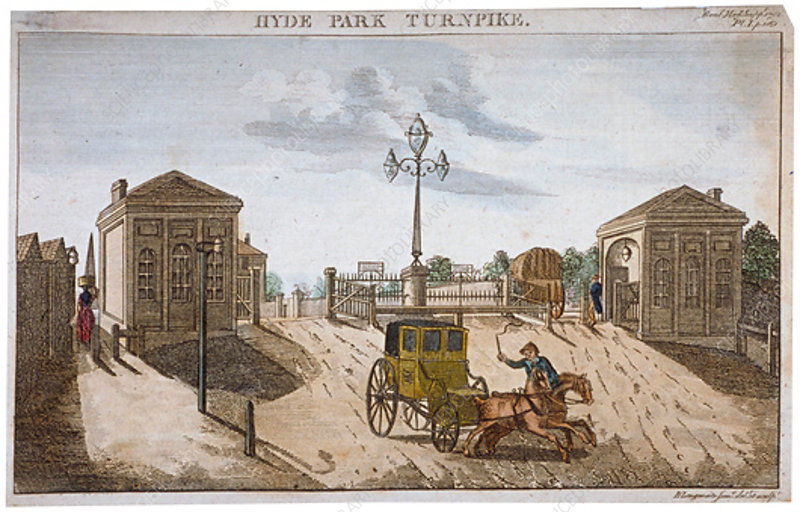
File:Hyde park turnpike toll gate.jpg
18thC print of Hyde Park Turnpike Gate
At some places along main roads, houses and gates were set up and a tollgate keeper lived alongside the route. These turnpikes continued to multiply slowly until by 1872, when the system was finally abolished, there were approximately 8000 turnpikes in operation.

A turnpike gate was a large gate which revolved on a spike and after the individual had paid his penny to use the turnpike the gate would revolve allowing access to the newly created turnpike road. Typical charges in the 17th Century were one penny for a horse and sixpence for a coach. Exempt from the charges were mail coaches, foot passengers and people in a funeral cortege. Because it was possible for brave horsemen to leap over the gates without paying, the gate was sometimes replaced by what soon became known as a 'turnpike': a wooden bar with spikes on top. 

Of course I will have to include this sort of a leap over a Turnpike in my next book!