AddThis

Bookmark and Share
Showing posts with label Katherine Fanshawe. Show all posts

Sunday, 27 September 2015

Ghosts of Markyate Manor - Hermit, Heiress, Highwayman

Markyate Manor - scene of many hauntings, is the setting for the Highway Trilogy: Shadow on the Highway, Spirit of the Highway, and Lady of the Highway.

The name Markyate is derived from the Old English words meac  and geat and means 'the gate at the boundary', presumably between Hertfordshire and Bedfordshire. In the 12th century, with the consent of his abbot, a monk went out from st Alban's and into the woods to seek a place to make a hermitage. God apparently guided him to Caddington, not far from Watling Street. There he lived a solitary life, until a woman came to him, Christina, in the firm belief that she too was called to a silent life of contemplation. He duly fastened her into an adjoining cell, where she was walled in for for four years!  She saw nobody in all that timeonly coming out to walk at dusk when she would see not a soul, supporting herself through her exquisite needlework. She was (unsurprisingly) taken over by heavenly visions, and when the original monk died she had gathered quite a following and was allowed to set up  a priory under Benedictine rule. The seal of the Priory can be seen above, and more about Christina's extraordinary life can be found here.

The Priory did not fare well during the dissolution because it had become run down, and there were charges of corruption and lack of chastity brought against the nuns. The Priory was eventually demolished in 1537, and Markyate Manor was built on its footprint, although it is still sometimes known as Markyate Cell -  George Ferrers retained the name when he bought the land in 1548. The Ferrers family controlled this land when Markyate Cell was the home of Katherine Ferrers, also sometimes known as The Wicked Lady, a title I am hoping to overturn!
Markyate Manor BBC

The Manor was left to Katherine by her mother, but it was soon in the control of her uncle, Simon Fanshawe, and she was forced into an arranged marriage with his nephew, Thomas Fanshawe.  After that, the story gets even more interesting as the legend credits her with being a notorious highwaywoman. She lived in the house through the years of the turbulent English Civil War, much of it alone as her menfolk were away fighting. She finally died there, having been mortally wounded trying to rob a coach on Nomansland.

markyate-cell-gen-mag-1846-large_sm
Her ghost has been seen dressed in highwayman clothes riding her horse at full gallop, and in 1840 part of Markyate Cell was destroyed by fire, and the blaze was blamed on Lady Katherine.  Whilst helping to put out the fire several locals said that they felt a ghostly presence and that they were being watched, by the ghost of Katherine. But Katherine is not the only ghost that haunts this building - in the late 1850s workmen repairing a wall saw the figure of a nun. Perhaps this was the anchorite Christina. The nun has been seen several times since, walking in an avenue near St John's Church.

In 1957 the bypass around Markyate was being built. A night watchman was sitting by his brazier one night when he looked up and saw someone warming their hands by the fire. The figure was that of a young man who promptly vanished as the night watchman was looking at him. Was this an appearance of Markyate's legendary Phantom who may also haunt Hicks Road and the High Street?  Luton Paranormal Society

So it Spirit of the highway final ebook coverwas not just Lady Katherine Fanshawe that haunted Markyate Manor. There was also a young man.

There has always been  a mysterious figure, Ralph Chaplin, associated with the legend, although I can find no trace of him in historical records. That gave me fuel for thought, and led to the story-line for 'Spirit of the Highway'.

Like to know more? check out this article in the Daily Mail for a summary of the life and legend of Lady Katherine Ferrers (Fanshawe).
Spirit of the Highway is out today, published by Endeavour Press. It is suitable for teens 14+ (and adults too!).
Amazon US Amazon UK


Saturday, 21 March 2015

The Wicked Lady – Katherine Fanshawe


Image result for Magdalen Ki8ng Hall wicked Lady book

I am not the first writer to be inspired by the life and legend of Lady Katherine Fanshawe.

The first novel based on her life was by Magdalen King-Hall who wrote a book called The Life and Death of the Wicked Lady Skelton in 1945. I have a copy and it is exciting reading, though long-winded in the telling by today’s standards. The book was a smash hit in its day and was made into a film - The Wicked Lady.


The film starred Margaret Lockwood in the title role as a nobleman's wife who secretly becomes a highwayman to relieve her life of boredom. The mystery of why she would take such an extreme action was the sensation of its day – women were supposed to be safe at home doing the housekeeping! The film had one of the top audiences ever for a film of its period, 18.4 million – a staggering number. I can remember my mother talking about it as one of her favourite films.
It was one of the Gainsborough melodramas, a sequence of very popular films made during the 1940s in wartime Britain. They provided pure escapism from the deprivation of WWII, with lavish sets and costumes and period settings, and the films were often based on historical novels.

Here is the trailer for the 1945 film – great costumes, but from it you get the melodramatic flavour of the plot. In fact, before it could be released in the US, re-shooting was required as the women's bodices were very low-cut and showed too much cleavage for the American censors.


It was such a hit that the film was re-made in 1983 and starred Faye Dunaway in the lead role. (Poster from www.moviepostercompany.co.uk) The film was a disaster and earned Faye Dunaway an award for the Worst Actress!


In my retelling of the story I have stuck to historical facts more than King-Hall did, including keeping the original names. Research into the background of the English Civil War provided me with plausible plot devices that enabled me to stick with the history more closely. However, as this is a novel for younger readers (14+) I wanted to retain the swashbuckling feel if possible, without making it into a melodrama. My story is told over three stand-alone books with three different points of view, the first book, Shadow on the Highway, is told from the point of view of Abigail, Lady Katherine’s deaf maidservant. You can find out more about how I researched her here.

This post first appeared on the Let Them Read Books Blog. Why not visit the site for more historical fiction, and interesting guest posts.

Wednesday, 6 August 2014

The State of English Roads in the 17th Century

As Shadow on the Highway is about highway robbery, it features a lot of travel by horseback, so I thought I'd share some snippets of my research. Anyone with information to add to my growing collection of data about Stuart roads, I'd be glad to hear from you. Thanks to Hoydens and Firebrands, where this post was first published.

Even though it has been a dry summer, the roads near my house are full of pot-holes thanks to a wet winter and not much money spent on road maintenance. But how were roads and highways maintained in the Stuart Era? 

waggon1700

Most goods were transported from the ports to the interior of the country by pack horses and so tracks were the routes most commonly followed. There were no signposts in the 17th Century, so you had to either know the route already or employ a guide. Most roads passed through areas that were still deeply forested, and would in no way resemble the sort of roads we have now. In Henry VIII's reign the use of the heavy waggon and springless cart became more common, and as prosperity increased there was more need for wider roads. A large waggon was also more economical for transporting items in bulk. The dust surface of these new broad roads became mud in winter, and so in 1555 the Statute of Philip and Mary was passed which provided a strategy for maintaining the roads.

17th Century routes through the towns and forests
of England, hunting horns denote forests
This act, which lasted right through Stuart times made the parish instead of the Lord of the Manor responsible for the upkeep of the highway. What this meant in effect was that if a road passed through your parish, it was your job to keep it in good condition. In order for this to work, each parish had to appoint a Surveyor of Highways. His duty was to inspect the road, and should it need work, he could call on each of the parishioners to do six days of road mending. Materials could be legally taken by the Surveyor from anyone's land for this task, and stones, rubble or earth removed without the landowner being recompensed for damage to the property. Naturally the Surveyor of Highways was not a popular person, as very few wanted to spend six days labouring and his inspections usually meant trouble as he took materials for repair from local landowners.

This system did not work particularly well and meant roads were often impassable in bad weather. Particularly bad were the routes in and out of the capital. But in 1656, tired of the responsibility of maintaining The Great North Road, the people of Radwell in Hertfordshire petitioned the Quarter Sessions for help, because this was the major route in and out of London. Probably as a result of this, Parliament passed a bill that gave the local justices powers to erect toll-gates on a section of the Great North Road for a trial period of eleven years, and allowed that the revenues collected should be used for the maintenance of the road. 

This being a success, to assist in the repair of roads, after 1663 groups of wealthy landowners were given permission by Parliament to build or improve a stretch of road and then charge tolls to get their money back, thereby allowing them to make a profit. These were called Turnpike Trusts. At first these toll roads were short and acted as short cuts, often bypassing a village and thus reducing its trade. 

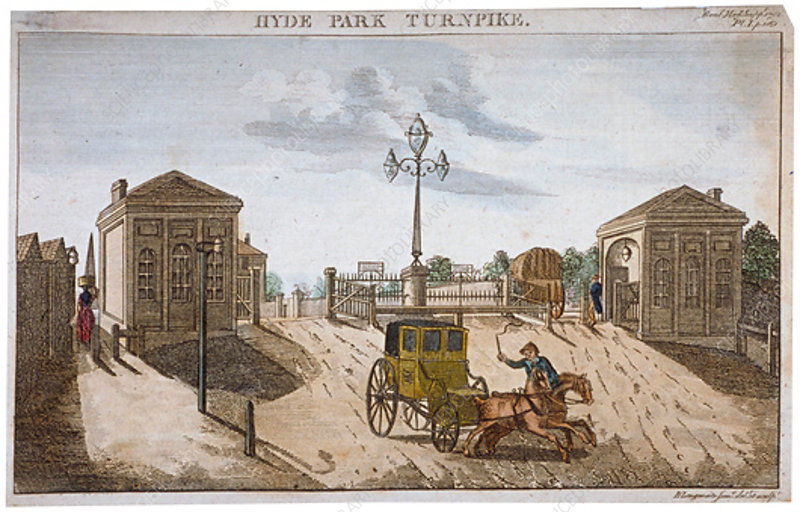
File:Hyde park turnpike toll gate.jpg
18thC print of Hyde Park Turnpike Gate
At some places along main roads, houses and gates were set up and a tollgate keeper lived alongside the route. These turnpikes continued to multiply slowly until by 1872, when the system was finally abolished, there were approximately 8000 turnpikes in operation.

A turnpike gate was a large gate which revolved on a spike and after the individual had paid his penny to use the turnpike the gate would revolve allowing access to the newly created turnpike road. Typical charges in the 17th Century were one penny for a horse and sixpence for a coach. Exempt from the charges were mail coaches, foot passengers and people in a funeral cortege. Because it was possible for brave horsemen to leap over the gates without paying, the gate was sometimes replaced by what soon became known as a 'turnpike': a wooden bar with spikes on top. 

Of course I will have to include this sort of a leap over a Turnpike in my next book!