AddThis

Bookmark and Share
Showing posts with label Stuart. Show all posts

Wednesday, 6 August 2014

The State of English Roads in the 17th Century

As Shadow on the Highway is about highway robbery, it features a lot of travel by horseback, so I thought I'd share some snippets of my research. Anyone with information to add to my growing collection of data about Stuart roads, I'd be glad to hear from you. Thanks to Hoydens and Firebrands, where this post was first published.

Even though it has been a dry summer, the roads near my house are full of pot-holes thanks to a wet winter and not much money spent on road maintenance. But how were roads and highways maintained in the Stuart Era? 

waggon1700

Most goods were transported from the ports to the interior of the country by pack horses and so tracks were the routes most commonly followed. There were no signposts in the 17th Century, so you had to either know the route already or employ a guide. Most roads passed through areas that were still deeply forested, and would in no way resemble the sort of roads we have now. In Henry VIII's reign the use of the heavy waggon and springless cart became more common, and as prosperity increased there was more need for wider roads. A large waggon was also more economical for transporting items in bulk. The dust surface of these new broad roads became mud in winter, and so in 1555 the Statute of Philip and Mary was passed which provided a strategy for maintaining the roads.

17th Century routes through the towns and forests
of England, hunting horns denote forests
This act, which lasted right through Stuart times made the parish instead of the Lord of the Manor responsible for the upkeep of the highway. What this meant in effect was that if a road passed through your parish, it was your job to keep it in good condition. In order for this to work, each parish had to appoint a Surveyor of Highways. His duty was to inspect the road, and should it need work, he could call on each of the parishioners to do six days of road mending. Materials could be legally taken by the Surveyor from anyone's land for this task, and stones, rubble or earth removed without the landowner being recompensed for damage to the property. Naturally the Surveyor of Highways was not a popular person, as very few wanted to spend six days labouring and his inspections usually meant trouble as he took materials for repair from local landowners.

This system did not work particularly well and meant roads were often impassable in bad weather. Particularly bad were the routes in and out of the capital. But in 1656, tired of the responsibility of maintaining The Great North Road, the people of Radwell in Hertfordshire petitioned the Quarter Sessions for help, because this was the major route in and out of London. Probably as a result of this, Parliament passed a bill that gave the local justices powers to erect toll-gates on a section of the Great North Road for a trial period of eleven years, and allowed that the revenues collected should be used for the maintenance of the road. 

This being a success, to assist in the repair of roads, after 1663 groups of wealthy landowners were given permission by Parliament to build or improve a stretch of road and then charge tolls to get their money back, thereby allowing them to make a profit. These were called Turnpike Trusts. At first these toll roads were short and acted as short cuts, often bypassing a village and thus reducing its trade. 
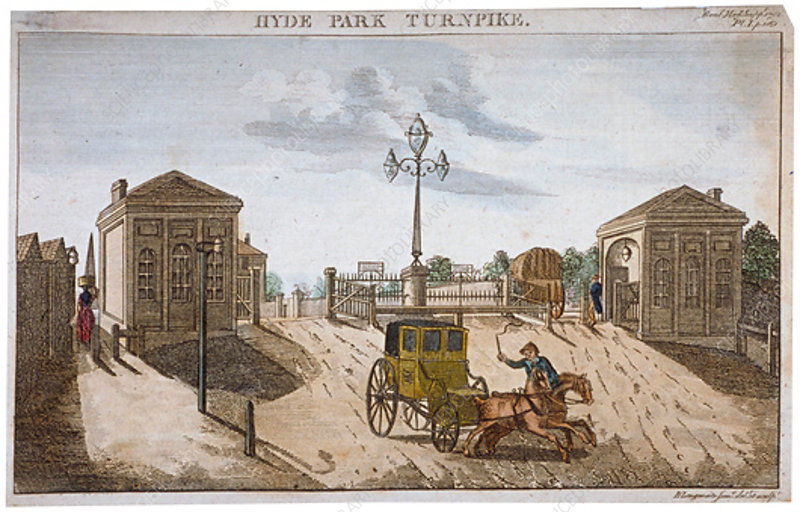
File:Hyde park turnpike toll gate.jpg
18thC print of Hyde Park Turnpike Gate
At some places along main roads, houses and gates were set up and a tollgate keeper lived alongside the route. These turnpikes continued to multiply slowly until by 1872, when the system was finally abolished, there were approximately 8000 turnpikes in operation.

A turnpike gate was a large gate which revolved on a spike and after the individual had paid his penny to use the turnpike the gate would revolve allowing access to the newly created turnpike road. Typical charges in the 17th Century were one penny for a horse and sixpence for a coach. Exempt from the charges were mail coaches, foot passengers and people in a funeral cortege. Because it was possible for brave horsemen to leap over the gates without paying, the gate was sometimes replaced by what soon became known as a 'turnpike': a wooden bar with spikes on top. 

Of course I will have to include this sort of a leap over a Turnpike in my next book!

Thursday, 13 October 2011

Limning - the exquisite art of the Tudor miniature

Limning is a thing apart from all other painting or drawing, and it excelleth all other painting whatsoever in sundry points

Nicholas Hilliard

'Limning' was the contemporary term in Tudor and Stuart times for miniature paintings, portraits which were portable and could be held in the hand. In the days before photography, these likenesses were much prized, and the making of them was considered to be a specialised art, apart from general portrait painting with its own skills and techniques. Many of these special techniques stemmed from those used in medieval manuscript illumination.

Miniatures were designed to be worn as pieces of jewellery too and were kept protected in delicate cases of gold or ivory, or stored in cabinets of rare imported woods. Most limners were also jewellers, as was the case with Nicholas Hilliard, probably England's best known limner.

The painting was done on vellum, the skin of an unborn calf, which is hairless and made the fine surface needed for such small work. It was then backed onto card - often a playing card to give enough rigidity. Dry colours were bought from the apothecary and mixed with a binder in mussel shells. The brush - then known as a pencil- was made from one or two squirrel hairs.


The elaborate clothing in court portraits as in the one of Elizabeth I, left, was brought separately to the studio so that Hilliard could paint the detail without tiring the sitter. This portrait, somewhat idealized, was painted when Elizabeth was in middle age.

Real gold and silver were applied with gum arabic and burnished using an animal tooth set into a handle. To give the crisp effect of lace a more solid white pigment was dribbled painstakingly into its intricate pattern to leave a slightly raised effect. An even heavier paint was used to make raised droplets of "pearls". The sitters often appear paler than they would have when the painting was new because the Red Lake pigment fades in the light.


In Hilliard's Treatise concerning the Arte of Limning he tells us he is extremely fussy about cleanliness, and will not allow coal fires to burn where he is working, lest soot should fall on his work. Even more he urges those who wish to paint miniatures to wear only silk so that particles of lint and fibre might not fall on the work from their sleeves.


This portrait by Hilliard was identified as Mary, Queen of Scots, in the 18th century, although there is still some dispute.

The inscription 'Virtutis Amore' is an anagram of the name 'Marie Stouart.' The style and costume indicate it was actually made after her death as a memorial portrait following her execution in 1587.

I love the transparency of her veiling and the way Hilliard has treated all the different shades of white. I imagine it must have been very difficult to paint something so detailed after the sitter is dead - not to mention spooky!


Miniatures were often given as love tokens or signs of political loyalty. Some portraits have a hidden symbolic meaning that has been lost to us, such as this young man against a background of flames, holding a portrait of a lady. Perhaps he was indicating a flaming passion, or perhaps survival from a catastrophic event.

The art of limning was passed down from master to apprentice. Hilliard was first apprenticed to Robert Brandon, a Goldsmith in Westcheap at the Sign of the Gilt Lion and Firebrand. (What a great name!)

In his turn Hilliard employed Isaac Oliver as his apprentice, and he also became very fashionable in Court circles, almost ousting his master. Isaac Oliver's family were Huguenots and fled France to escape religious persecution. He became known for his realistic treatment of children and his slightly less formal portraiture. Below you can see delightful portraits of two Elizabethan girls.


In The Lady's Slipper, Alice's father encourages her to take up miniature painting. Alice finds the techniques and scale of the work too exacting and decides instead to study botanical painting. However, I loved looking into the art of the miniature and really came to appreciate the skill involved in these small jewel-like portraits. Pictures are courtesy of the V&A museum.
