AddThis

Bookmark and Share
Showing posts with label deborah swift. Show all posts

Sunday, 9 March 2014

The Ideal Home of 1609


In A Divided Inheritance, Elspet Leviston stands to lose her family’s house and business to a cousin she never knew existed. To recreate the house in my mind I researched the late Elizabethan and Early Jacobean style – a period much overlooked, but with its own distinct characteristics.


Elspet lives in London and her house has been in the family for generations, so it is likely that the actual fabric of the building would have been Tudor or even earlier, but with more modern furnishings. She also tells us in the novel that her father is quite reluctant to update the house – to buy new drapes or replace worn items. Westview House in the novel would be quite shabby, but with good quality furniture. In the picture below of Crewe Hall, notice the typical ceiling of the period with its pendant plasterwork, which would soon have grown grubby from the smoking fires and tobacco.

Crewe_Hall_Dining_Room
Crewe Hall Dining Room
I used a real house to model Elspet’s home on. I find it much easier to write if I have a good sense of the geography of a house and a real picture of where doors, windows and so forth would have been. I couldn’t find a suitable house in London of the right middling size, though I used the street map of the time to locate where the house would have stood. Much of this area of London was lost in the subsequent Great Fire of 1666.

The house I chose to use is Bampfylde House which is actually in Exeter, but was the period and style which would have been similar to London houses of the time. Sadly this building no longer stands, as it was destroyed by incendiary bombs in 1942. Such a catastrophe! It had survived right up until the twentieth century intact. But there is a fascinating article about its history here, along with interesting tales of when it was visited by the Duke of Bedford.

bampfylde house
Bampfylde House

The paintings of the house were done by Robert Dymond, an antiquarian who visited it when it was still there, in 1864. The house has a small courtyard and the front, and a larger one behind, which I make good use of in the novel for Zachary Deane’s sword practice.
Oak Room Bampfylde House_Exeter
Oak Room, Bampfylde House
Jacobean furniture was massive, heavy and built to last. Often from oak, and built on simple lines, it is characterised by ornate carvings, and friezes of decorative designs. Chairs were probably quite uncomfortable as upholstery was little-used.

 Shutters were used at the mullioned windows to keep in the warmth, and drapes possibly hand-embroidered with crewel work. Here are some examples of crewel work designs from the Victoria and Albert museum. Elspet’s mother may have spent long hours embroidering items such as these, and rubbing them with lavender or sandalwood to keep off moths.
Crewelwork 1630 V&A
Crewel_curtain late 17thC V&A
It was crucial to me to have a real sense of what Elspet might lose if she failed to keep her family’s house, so the reader can empathise with that. Re-creating the dark, somewhat structured interior of the house was also vital as a contrast to what Elspet later finds in Spain when she has to pursue her cousin to hot and dusty Seville. At the time Seville is the busiest port in Europe during Spain’s Golden Age, full of new and exciting sights, scents and sounds. There Elspet finds a completely different lifestyle, architecture and customs. Not only that, but she finds a new physical freedom she could never have found in London.

By the way, those interested in Jacobean houses might also find this article of interest – how Apethorpe Hall, a Jacobean treasure, was saved by one man.

Picture Credits:
This article first appeared on The Bookish Librarian Blog

DEAR READERS, MY BLOG HAS NOW TRANSFERRED TO MY WEBSITE www.deborahswift.com  please visit me there for further updates!

Sunday, 1 September 2013

Historical Fiction Short Stories - the HNS Anthology #histnov


I'm delighted to announce that my story 'A Dog's Life' is featured in this wonderful anthology of short stories from the Historical Novel Society - going to press today and shortly available on Kindle. I can't wait to read my copy and all the other short stories by my fellow writers. Thanks to Carol McGrath for her hard work co-ordinating this.

My own story is set in a snowy winter in the winding streets of Restoration London near the frozen Thames. I was inspired to write the story when I read an eye-witness account about what happened to the Thames when it finally began to thaw.

Below is another wonderful book about the frozen Thames - Helen Humphreys' lovely cameos of the frozen Thames through history. And of course the frozen Thames also features in my novel 'The Gilded Lily' - currently on special offer on kindle.

Thursday, 28 February 2013

The Origins of the Quaker Pledge for Peace


'We utterly deny all outward wars and strife and
fighting with outward weapons for any end or under any pretense whatever; this is our testimony to the whole world'


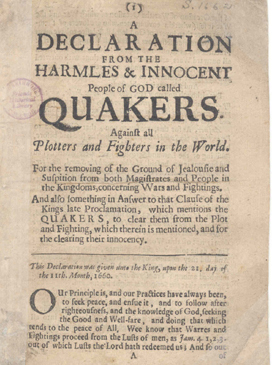
On the 21st November 1660 George Fox, founder of the Society of Friends, or Quakers, drew up a declaration for peace and presented it to the newly restored King, Charles II.

Fox's jounal indicates that the document was suppressed when he tried to publish it, saying that it was taken from the presses by the city authorities.

Notice how on the document, they refer to themselves as 'harmless and innocent' and say the declaration is against 'all plotters and fighters in the world.' These words are specifically to distance themselves from the Fifth Monarchists - a sect led by Thomas Venner who caused about forty deaths in an uprising in January of that year. In fact because of these uprisings the King outlawed Fifth Monarchists, Baptists and Quakers from holding public meetings and all members of these sects were required to take an Oath of Allegiance to the King.

The Fifth Monarchists were a radical religious movement that used both social and political pressure to effect their message and vision of a new religious "Golden Age" which they thought was about to begin, with the literal coming of the Messiah. 


The riot began whenThomas Venner and his men wanted to gain control of St Paul's Church (then not a cathedral) and took his men to a bookseller called Mr. Johnson to demand the Cathedral keys. (Pepy's diary)

Upon being refused they broke in to the shop and accosted passers-by asking who they were for, presumably meaning whether they were for the King (Anglicanism) or for the non-conformists. One answered him "King Charles" and they dispatched him with a shot through the heart. A scuffle ensued and trained bands of soldiers had to be brought in by the monarchy to quell the unrest.
In later days Venner tried to storm the Comptor Prison to liberate the inmates so they could increase their ranks, but they were repulsed in fierce fighting. To give an idea of the brutality of fighting in these times, Venner is said to have killed three men with a halberd in Threadneedle Street.
TheFifth Monarchists made their last stand in two pubs, the Helmet Tavern on Threadneedle Street and the Blue Anchor on Coleman Street. Esconced inside they were only routed when Royalist troops smashed through the clay roof tiles with musket butts and fired down through the ceiling. Venner was captured after being wounded nineteen times, and put to death alomst immediately by hanging.
No wonder Fox and his colleagues sought to dissassociate themselves from Venner's sect.
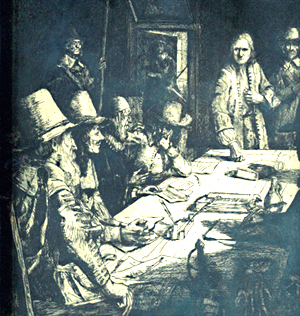
George Fox at Holker Hall 1662 


Since that time Quakers have kept their peace promise. I have often thought that in earlier times it must have been a much more difficult feat to achieve. In The Lady's Slipper  the Quaker, Richard Wheeler, struggles with the pledge of non-violence. He lives in a society where disputes are settled by the sword. How will he fare when he has to defend the life of the woman he loves?
More about the Peace Declaration can be found here


Picture from the Kendal Quaker Tapestry http://www.quaker-tapestry.co.uk

Thursday, 22 November 2012

Literary Sisters and the Italian Belle Epoque

How would you feel if your sister burnt your manuscript?

My post on the turbulent life of literary sisters The Brontes is over at Enchanted by Josephine, a blog that more often specializes in book reviews and posts about French Royalty and La Belle Epoque. I thought a bit of Yorkshire grit and the wild moors would make a nice contrast over there.

For those of you more used to me talking about the wilds of Westmorland I thought I'd bring a flavour of Enchanted by Josephine over here. Below is a picture from an exhibition of the Italian Belle Epoque. I love this picture of a woman sewing. More similar pictures can be seen at the Dolce Vita blog: or why not visit Enchanted by Josephine where you can click to enter a Giveaway of THE GILDED LILY.
Scroll down for snow!

La Belle Epoque Italiana


And for anyone wondering why there is no snow yet on this post (The Gilded Lily is set in the snow of the winter of 1661) - here it is! A picture of Gabrielle Ray who was known as one of the most beautiful women of the Edwardian Era and often photographed. This photo came from a blog dedicated to Gabrielle Ray - click on it to take you there.


Monday, 5 November 2012

The Next Big Thing - A Divided Inheritance by Deborah Swift

I've been tagged in The Next Big Thing by fellow writers Gillian Bagwell and Debra Brown. Do click on their names to find out about Gillian's exhaustive research and Debra's new Victorian romance. I'm instructed to tell you all about my next book by answering these questions and then to tag five other authors about their Next Big Thing. So here I go!
What is the working title of your next book? 
A DIVIDED INHERITANCE, scheduled for publication next September.

Where did the idea come from for the book?


Viggo Mortensen - Alatriste
Three things -
one was the idea of exploring how much of our inheritance we take for granted. Our inheritance such as our cultural expectations and identity, and what might happen if these were challenged. I wanted to show that a 17th century woman could survive in a man's world, despite the expectations of the age.

At the same time as I was mulling over this, I came across a fascinating book about 17th century fencing masters and thought it would be interesting to research women who fought using rapiers and to find out more about whether any women used these training techniques. I have an interest in this through practising swordplay through martial arts. The particular Spanish training method I was researching is an esoteric system designed to produce a kind of 'Renaissance man' - or in this case, woman.

I was also interested in a period of history in Spain where there was massive cultural change and Phillip II expelled a large population of Spanish citizens - an act that divided families and was to impoverish Spain for generations.So this seemed an ideal backdrop for my family drama.

What genre does your book fall under?
It is historical fiction - literary rather than romantic, but I hope a good page-turner too.
Which actors would you choose to play your characters in a movie rendition?
I was very impressed with the film 'Alatriste' which I watched for some of my research into the Spanish fighting arts, and so I'd go for Viggo Mortensen. I also loved him in Lord of the Rings. For the female lead role I would choose Anne Hathaway who when she played Jane Austen had the quality of Englishness appropriate for my female lead Elspet Leviston..


What is the one-sentence synopsis of your book?
A DIVIDED INHERITANCE is set in 1609 and is the story of a woman whose life is turned upside down when a cousin she has never met arrives unannounced at her house. It is a story of courage, hope and the triumph of kinship over adversity. 
Will your book be self-published or represented by an agency?
The book has already been sold to Pan Macmillan via my agent Annette Green.
How long did it take you to write the first draft of your manuscript?
About eighteen months, of which six months was solid research. I travelled to London to the museums and to get a sense of the early Jacobean architecture, and also to Seville where I was knocked out by the Alcazar Palace and the wonderful Moorish palaces and decorative arts such as ceramics. I visited museums and galleries there and then did lots of further research through archives and by writing to swordplay experts in Spain and the US. Once most of the background research was done I wrote fairly intensively every morning. At the moment the book is being copy-edited, and I'll expect more small points to be smoothed out at that stage, and after that it will be proof-read.
What other books would you compare this story to within your genre?
I've no idea! Other people compare my books to Philippa Gregory, Tracy Chevalier and Jane Harris - these are all very different writers, so I guess I'm happy to just be myself! I enjoy to read historical adventures such as Ken Follett's Pillars of the Earth and the C.J Sansom thrillers too, so perhaps there is some influence there, ans similarly, I write about ordinary men and women from the past who are caught up in extraordinary circumstances.
What inspired you to write this book?
I was inspired by the wonderful Moorish architecture of Seville, and its passionate flamenco culture. I wondered how an Englishwoman might cope in Golden Age Spain, which was a hotbed of religious dissent, and where people lived in fear of the Inquisition. I was also inspired by the idea of how deeds from the past might come to bear on one's children, even when they are grown up. And I wanted to explore how people with nothing in common can band together under adversity.
What else about your book might pique the reader's interest?
Well, here's the blurb so far - which I am working on at the moment. Condensing a very large book into 150 words is a difficult exercise!


~ London 1609 ~

Elspet Leviston hopes to follow her scholarly father Nathaniel into the lace trade, but already Nathaniel’s past is on its way back to haunt her. Her hopes are threatened by the arrival of her mysterious cousin Zachary Deane – a man who has his own ambitions for Leviston’s Lace.

But wherever Zachary goes trouble seems to follow. So Nathaniel sends him on a Grand Tour, away from the distractions of Jacobean London, and Elspet believes herself to be free of her interfering relation. But when Nathaniel dies, Elspet’s fortunes change dramatically and she is forced to leave her beloved home and go in search of Zachary, determined to claim the inheritance that is rightfully hers.

Under the searing Spanish sun Elspet and Zachary find themselves locked in a battle of wills,
But Seville is a dangerous place and soon they are embroiled in the roar and sweep of a tragedy that will set them both on a journey of discovery, and unlock for them the mystery of what family really means.
Here are some more lovely authors I've tagged to tell you about their Next Big Thing! 
Gabrielle Kimm 
Len Tyler
Katherine Clements
Charlotte Betts
Sue Millard

Wednesday, 12 September 2012

Desert Island Books - Castaway Deborah Swift

I'm going off to tour the blogosphere and while I'm away I've invited a few other authors to my Deserted Blog. Whilst they are here they'll share their Desert Island Books.Needless to say I'm a big fan of the Radio 4 show, Desert Island Discs.

Each author has chosen one classic, one modern and one non-fiction book to take to their Desert Island, along with one of their own books, just to remind them how clever they are!

Before I go off tomorrow, here is my selection:

Here's my classic. Why? Because it's long - very long, and I might not be rescued for a very long time! It also has lots of  fantasy and material for daydreaming. I might even want to edit it and re-write sections. I can never resist a bit of editing! Also I figured that the landscape of Middle Earth is about as far as I could get from the desert island.


I loved Wolf Hall, but I'm daunted by another the size of this. On my island I'd have plenty of time to really savour Mantel's magnificent writing style.
I don't know if I'd have painting things on my island, but I'd certainly want to meditate on nature and my surroundings, and if not I could enjoy the change of view this book would give me.


And of course I would take a large stack of paper to keep writing until someone rescues me! (possibly of course the only thing I might write is SOS in large letters!)

Tomorrow my Desert Island Castaway is Orange-nominated and Langum Prize winner Ann Weisgarber, and I will be at Bippity Boppety Book and Lit Addicted Brit


Friday, 25 May 2012

Books on The Pendle Witches - 400 years ago this year

I parked in a car park opposite this pub, The Golden Lion, a few weeks ago on the way to the shops in Lancaster. As I passed it I remembered that this was the spot where the famous Pendle witches stopped for a last drink before being taken to Gallows Hill to be executed.

I stopped to read the two plaques that are on the wall. The scroll gives the passer-by a little information, and the brass plaque is like a memorial and lists the names of those who were executed.

The year was 1612, exactly 400 years ago - a turbulent time in England's history, an era of religious persecution and superstition, under the reign of James I. At the foot of Pendle Hill, (later the inspiration to George Fox's Quaker Movement) nine villagers were accused of witchcraft following the deaths of several people in and around the Forest of Pendle, and they were later sent to trial at Lancaster Castle, where they were found guilty and then executed.

In both my books, The Lady's Slipper and The Gilded Lily, the shadow of witchcraft hangs over the women of Netherbarrow in Westmorland. In The Lady's Slipper Alice Ibbotson spends time in Lancaster Castle accused of witchcraft, just as the Pendle witches did, and in The Gilded Lily, Sadie Appleby is terrified of being accused of being a witch because of a birthmark on her face.

In the 17th century witchcraft was blamed for anything that could not be rationally explained, and the fact that James I was obsessed with finding witches did little to help the causes of those people, mostly women, who were accused.This extract showing how people were afraid of witchcraft is from the excellent Pendle Witches website, where there is a wealth of information on the women themselves and on the trials and executions. www.pendlewitches.co.uk

"During the sixteenth century whole districts in some parts of Lancashire seemed contaminated with the presence of witches; men and beasts were supposed to languish under their charm, and the delusion which preyed alike on the learned and the vulgar did not allow any family to suppose that they were beyond the reach of the witch's power.


Was the family visited by sickness? It was believed to be the work of an invisible agency, which in secret wasted an image made in clay before the fire, or crumbled its various parts into dust.


Did the cattle sicken and die? The witch and the wizard were the authors of the calamity.Did the yeast refuse to ferment, either in the bread or the beer? It was the consequence of a 'bad wish'.


Did the butter refuse to come? The 'familiar' was in the churn.


Did the ship founder at sea? The gale or hurricane was blown by the lungless hag who had scarcely sufficient breath to cool her own pottage.


Did the river Ribble overflow its banks? The floods descended from the congregated sisterhood at Malkin Tower.


The blight of the season, which consigned the crops of the farmer to destruction, was the saliva of the enchantress, or distillations from the blear-eyed dame who flew by night over the field on mischief bent."
From History of Lancaster 1867 - Thomas Baines.


If you are interested in reading a novel about the Pendle witches then I can recommend Robert Neill's "Mist over Pendle". A nice review of it is over at What Kate's Reading.

Alternatively you might try "Daughters of the Witching Hill". You can read an interview with Mary Sharratt here about her process of writing.

Events to commemorate the Pendle Witches are happening throughout the year of 2012.
Those listed below are just a few. More information from Lancashire Witches 4000

"Sabbat" at the Dukes and Hoghton Tower
Witches Art Trails through the Forest of Bowland
`A Witch-Themed Murder Mystery` at Lancaster Castle
The Crucible by Arthur Miller at Lancaster Priory
Exhibition by Joe Hesketh – The Pendle Investigation, The Dukes
Lecture - Fair Trial or a Foul Bill - The Legal Significance of the Lancashire Witch Trials, Lancaster Priory
Service - In Solidarity with Victims of Persecution and Hate Crime, Lancaster Priory
Exhibition: Spellbound: Superstition, stories and the silver screen
Exhibition: A Wonderfull Discoverie: Lancashire Witches 1612-2012
Witches and Guy Fawkes Festival
Lancashire Witches Guided Walks around Lancaster City
Guided tours of Lancaster Castle.
A multimedia exhibition spanning time and place: “Witch Hunts, then and now”

h

Monday, 25 October 2010

Snippets from the Historical Novel Society Conference

The venue for this year's conference was the Mechanics Institute in Manchester, a solid edifice with an imposing stone staircase and walls full of prints and ephemera from the history of the Trades Unions.

Unfortunately I couldn't be in two places at once so I had to make choices about which speakers I would listen to. The first was Mary Sharratt - seated in amongst us at a round table around which we all squashed ourselves - she was a very popular speaker and rightly so. Her talk on "The Daughters of Witching Hill", her new novel, was exemplary. She gave us plenty of historical detail about the religious and social background to the book -  how the Reformation changed attitudes to Catholicism, how the 17th century beliefs in spirits and the power of the cunning woman were repressed during the rise of Puritanism. Her extracts were well-chosen, and we all got to hear her read a little of the voices of the characters, during which you could hear a pin drop. She had photocopied some chapbooks and documents of the time which she referred to, and these added a note of veracity to what was a very well-planned and interesting session. And "The Daughters of Witching Hill" sounds like a great read.

Robert Low was next, talking about Reportage, Re-enactment and Fiction. A very imposing-looking man with a plaited beard, he looks as his readers might hope he would. His lively talk ranged across his experiences as a war reporter and re-enacter. As he pointed out, historical fiction is a genre with no awards, no specific shelf in a bookshop.

And for myself, probably my affinity with Viking, Roman or other so-called Sword and Sandals fiction is about the same as my affinity with Crime or Chick-Lit - i.e they are novels, but that's about as far as it goes. One end of the genre can feel miles away from another, separated by aeons in both time and writing style. So it always feels a little odd for us all to be lumped together in one genre.


But as a novelist Robert had some great things to say about the writer remaining invisible, listed with great good humour. My favourites were "Never open with the weather - the reader is looking for people","Try to leave out the parts readers skip", "If it sounds like writing, re-write it."

He said whatever the accuracy of our research in the end our "only obligation is to be persuasive," and I have to say this seemed a very good argument.

The Panel Discussion, "Where next for Historical Fiction?" chaired by Doug Jackson with Jim Gill (United Agents) Marcy Posner (Folio Literary Management) began by looking back to see where the current revival in interest in HF has come from, and traced it back to the rise of interest in historical  non-fiction, particularly Simon Schama's History of Britain, and books such as "Longitude" - non-fiction narratives which then paved the way for fiction. Readers like the "added value" of entertainment plus education that some HF provides. However, we need to be wary that we don't become so concerned with being accurate that we forget to write a novel! Story is key.

The conversation ranged over the power of the cover (8 seconds to make your choice in Tesco) to the fact that contrary to most writers' opinions, interest in the Tudors shows no sign of waning. On the contrary, readers like to read books where they already have a smattering of knowledge. Periods the reader has scant knowledge of will fail to sell. The English Civil War, although it has a lot going for it in terms of dramaic action, is apparently a difficult period as readers do not understand the complex causes of the conflict and therefore have no "in" on the subject. (Shame, as that is my period!)

Marcy Posner said there was absolutely no market for WWII novels in the States.

She also said that since the rise of ebooks and self-publishing it was interesting that no less than five new independent bookshops have opened in New York, indicating that the public are wanting a more informed choice and a personal service. Good news for all of us whose books are somewhere in the mid-list.

Both Jim and Marcy agreed that the job of the novelist includes being "out and about", although there is no hard evidence to show (certainly in the States ) that readings and tours work to sell more books. Generally, facebook, tweeting, blogs etc do not necessarily increase your profile as there is so much "information static" drowning out the potential to connect with readers. This was contested by some members who thought that they had successfully used these media to sell their own books.

In the afternoon I listened to a Panel Discussion on A History of Violence" and Ann Turnbull talking about Love and conflict in the 17th century. This was followed by Jean Fullerton's presentation "Ground your fiction in Fact." I also had a very entertaining lunch, and a discussion with two other writers about the benefits of the Kindle.More about these in my next post.

Thursday, 21 October 2010

The Gilded Lily to be published by Pan Macmillan

I am delighted to announce that my second novel, The Gilded Lily will be published by Pan Macmillan, date of publication to be confirmed soon.

The Gilded Lily is a companion volume to The Lady's Slipper, but can also be read as a stand-alone novel.


The Gilded Lily

a Winter of Snow and Ice 1661

Timid Sadie Appleby has always lived in her small village. One night she is rudely awoken by her older and bolder sister, Ella, who has robbed her employer and is on the run. The girls flee their rural home of Westmorland to head for London, hoping to lose themselves in the teeming city. But the dead man's relatives are in hot pursuit, and soon a game of cat and mouse begins.


Ella is soon obsessed with the glitter and glamour of city life and sets her sights on flamboyant man-about-town, Jay Whitgift. But nothing is what it seems - not even Jay Whitgift.


Can Sadie survive a fugitive's life in the big city? But even more
pressing, can she survive life with her older sister Ella?

Set in London's atmospheric coffee houses, the rich mansions of
Whitehall, and the pawnshops, slums and rookeries hidden from rich men's view, The Gilded Lily is about beauty and desire, about the stories we tell ourselves, and about how sisterhood can be both a burden and a saving grace.


At the same time as I was celebrating my own good news I heard that Terence Morgan, a fellow Macmillan New Writer and author of historical fiction, has signed a similar two book deal with Pan Mac. Check out his recent book, The Master of Bruges. His new one will be entitled "The Last Plantagenet."


Thursday, 30 September 2010

Meditation and Writing

My second book is waiting for the editor's verdict and I am in the glorious research period of the next. Nothing is set in stone yet, so my mind can range free over a multitude of possibilities. It's a great excuse to curl up on the sofa with a pile of good non-fiction books, a cat (hopefully) purring on my lap and a cup of tea on the windowsill behind me.

During this phase I seem to do a lot of daydreaming and free-thinking, writing down ideas on a large spider diagram, looking for concepts or characters that seem to fit together. I use my intuition in this "fitting together."

Research I'm doing at the moment is based around Spain at the turn of the sixteenth century, as I am fairly sure some of the next book will be set there, but I also have books on Stuart Cookery, The Lives of the English Rakes and The Book of the Sword on the go, as well as a great Taschen picture book on Alchemy and Mysticism. And that is only the top of the pile. So how does all this input become output?

For me, one of the answers is meditation. I have been a meditator for more than 30 years. Those of you who are thinking I have this meditation-thing taped after all this time would be mistaken - it is still a discipline to sit, and to still the mind every day, and not to jump up going "I must get on with the writing/washing-up/filing/whatever else needs doing."

But the length of practice means I know from experience that it is the antidote to the chock-a-block mind, that it provides a creative space for the less obvious to appear. Whilst the thinking mind is working out things on the surface, the meditative mind perceives the undercurrents, the subtleties, maybe not even the things I can instantly put into words, but the sense of direction of the ideas I am working with, what I sometimes call the "true north" of where I am going and what I am doing.

Many other writers have a repetitive activity such as running or swimming that they use to quieten the mind. Others use the process of writing itself. There must be thousands of people writing the recommended "daily pages" of The Artist's Way, in order to put themselves in touch with deeper aspects of themselves. For most writers, writing itself uncovers the self, and because of this it can feel as if you are baring the soul.

I am lucky that I know a group of other women who meditate and once a month we get to each other's houses to sit in silence together and then have tea. We are of all different persuasions, christians, buddhists, quakers, atheists, not-quite-sure's, yet we find a value in this silent coming together. When we sit in silence it is as if we contact all the other silences - for silence is silence, is the same silence.
This is one of the reasons I chose to write about the Quakers, as sitting in silence is their core activity.


The picture shows some of the women's meditation group at the launch of The Lady's Slipper outside Townend. I'm the one in the middle!


For those beginning writing and interested in meditation and the process of writing I can recommend "Writing Your Way" by Manjusvara and "Writing Down the Bones" by Natalie Goldberg.  These books contain a wealth of ideas and exercises to get you started, and are a great resource for Creative Writing tutors.

Wednesday, 2 December 2009

Interview on Writewords

http://www.writewords.org.uk/
You can find an interview with me on the Writewords writers website. For those that don't know, Writewords is one of the biggest resource sites for writers, with a chance to post your work to other writers for critique, and to chat to other writers in user-friendly forums.