AddThis

Bookmark and Share

Thursday, 28 February 2013

The Origins of the Quaker Pledge for Peace


'We utterly deny all outward wars and strife and
fighting with outward weapons for any end or under any pretense whatever; this is our testimony to the whole world'


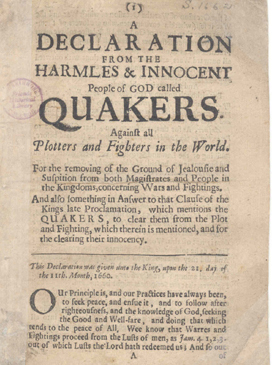
On the 21st November 1660 George Fox, founder of the Society of Friends, or Quakers, drew up a declaration for peace and presented it to the newly restored King, Charles II.

Fox's jounal indicates that the document was suppressed when he tried to publish it, saying that it was taken from the presses by the city authorities.

Notice how on the document, they refer to themselves as 'harmless and innocent' and say the declaration is against 'all plotters and fighters in the world.' These words are specifically to distance themselves from the Fifth Monarchists - a sect led by Thomas Venner who caused about forty deaths in an uprising in January of that year. In fact because of these uprisings the King outlawed Fifth Monarchists, Baptists and Quakers from holding public meetings and all members of these sects were required to take an Oath of Allegiance to the King.

The Fifth Monarchists were a radical religious movement that used both social and political pressure to effect their message and vision of a new religious "Golden Age" which they thought was about to begin, with the literal coming of the Messiah. 


The riot began whenThomas Venner and his men wanted to gain control of St Paul's Church (then not a cathedral) and took his men to a bookseller called Mr. Johnson to demand the Cathedral keys. (Pepy's diary)

Upon being refused they broke in to the shop and accosted passers-by asking who they were for, presumably meaning whether they were for the King (Anglicanism) or for the non-conformists. One answered him "King Charles" and they dispatched him with a shot through the heart. A scuffle ensued and trained bands of soldiers had to be brought in by the monarchy to quell the unrest.
In later days Venner tried to storm the Comptor Prison to liberate the inmates so they could increase their ranks, but they were repulsed in fierce fighting. To give an idea of the brutality of fighting in these times, Venner is said to have killed three men with a halberd in Threadneedle Street.
TheFifth Monarchists made their last stand in two pubs, the Helmet Tavern on Threadneedle Street and the Blue Anchor on Coleman Street. Esconced inside they were only routed when Royalist troops smashed through the clay roof tiles with musket butts and fired down through the ceiling. Venner was captured after being wounded nineteen times, and put to death alomst immediately by hanging.
No wonder Fox and his colleagues sought to dissassociate themselves from Venner's sect.
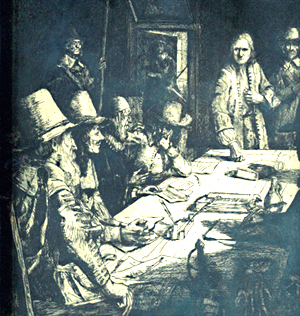
George Fox at Holker Hall 1662 


Since that time Quakers have kept their peace promise. I have often thought that in earlier times it must have been a much more difficult feat to achieve. In The Lady's Slipper  the Quaker, Richard Wheeler, struggles with the pledge of non-violence. He lives in a society where disputes are settled by the sword. How will he fare when he has to defend the life of the woman he loves?
More about the Peace Declaration can be found here


Picture from the Kendal Quaker Tapestry http://www.quaker-tapestry.co.uk

Sunday, 10 February 2013

Chocolate and Romance from the 17th Century

Blog hop icon
This Giveaway has now ended and the winner is Susan Heim! Congratulations to Susan, and thank you to everyone who commented, or followed me on Facebook or the blog.


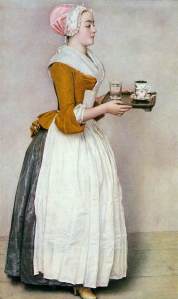
The Chocolate Girl
by Jean Etienne Liotard

I first wrote about this painting back in December last year in a post about maidservants, but I thought it was a great story for a Valentine's week post and worth highlighting again. I don't know if there is a novel based on this Cinderella-like tale, but it might make a good one. (No plans for it myself!)


The story behind the commissioning of this painting is a great romantic myth. The girl in the portrait, Anna Baltauf, worked as a maidservant in one of the Viennese chocolate shops which had become hugely popular during the 17th and18th centuries. She had little chance of good marriage as her father was too poor to give her a good dowry, however in the summer of 1745, a young Austrian nobleman - Prince Dietrichstein - came into the shop. He fell in love with the Chocolate Girl and asked her to marry him, despite objections from his family As a wedding present to his 'chocolate girl' he commissioned this portrait of his wife wearing the maid’s costume she was wearing when he first set eyes on her. Is this true? I guess we'll never really know.

Ella Appleby from my book The Gilded Lily would have loved this story. It was what she dreamed about for herself, that a prince might come and rescue her from her humdrum life. Sadie, her sister, would have gently told her to stop dreaming and to deliver the tray to the customer before the chocolate went cold.
More information about the story can be found here


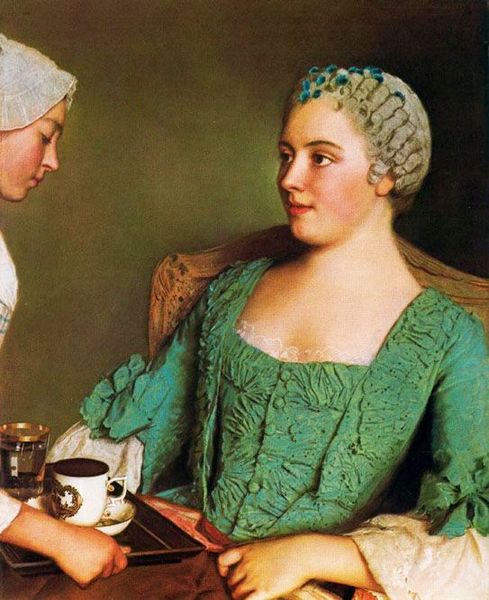
File:La prima colazione.jpgThe painting itself, formerly in Dresden, survived World War II and Allied bombs by being kept in a damp cellar in Konigstein Fortress  and brought back to Dresden after the Germans retreated from advancing Russian troops. Fortunately it seems none the worse, and is a wonderful portrait of costume and detail from the mid 18th century.

The same girl can be seen in one of Liotard's other works, 'The Breakfast.' 

I am offering two copies of THE GILDED LILY - one for the Hearts through History Blog Hop, and one for the League of British Artists Valentine Giveaway. (Click to take you there)
Both are International - wherever Book Depository delivers.

Please comment below to enter the Hearts Through History Giveaway and leave an email address. 
Two extra entries for following my blog, one extra entry if you 'like' my facebook page http://www.facebook.com/TheGildedLilyBook

Hop Participants - Hearts Through History 

Good luck everyone!

Wednesday, 6 February 2013

Thimbles - 17thCentury Engagement Rings


www.silive.com
Thinking about Valentine's Day ahead, I thought I'd share with you a snippet of research I discovered when I was writing my novel 'The Lady's Slipper' which features a woman who travels to the New World (ie America) in the 17th century.

I read that the Quakers and Puritans -some of the first settlers in the New World - did not like to wear jewellery, including wedding and engagement rings. This was because of their beliefs in living a simple and unostentatious life without embellishment or adornment - plain clothes in muted colours, and no unnecessary decoration.

17thC open-topped thimble www.treasurenet.com

Instead of the giving of a ring, it apparently became the custom for a betrothed couple to exchange a thimble. The thimble was something practical and was used by young women to sew household linens, and garments used as part of their dowry.

After the wedding, the man would cut off the cup of the thimble thus symbolizing that the young woman's sewing was over and the dowry was complete. The rim was then worn as a ring.
02 Le dé en argent de Fernande DESVIGNES
www.mercerieambulante.typepad.com
Some people dispute this claim, that thimbles were used as wedding rings, as a sort of 17th century urban myth. Click the link for the arguments against the idea.

Also, Quaker weddings at the time were not like the usual 17th century wedding in that they were agreed by the whole community of Quakers and subject to the feeling of the meeting as to whether the union was 'right.'

But being an old romantic, and loving a good story I like to think that young men would have used a romantic gesture like the giving of a thimble - so I prefer to believe this is true!