AddThis

Bookmark and Share

Friday, 12 July 2013

Why does a writer need four blogs?

A writer has limited time, so why would I want to commit myself to writing four blogs? Well here's why. Each blog has a function.

This blog - the one you are currently reading - is my writing blog, and on it I muse about my writing process, share technical or writing tips and reviews, and talk about my books. As you can see I have a small number of followers but they all have an interest in my books or my writing. 

My second blog, Royalty Free Fiction, was designed so I could widen my contact with other writers who enjoyed writing historical fiction, but were more interested in the ordinary person than in Kings and Queens. I also hoped this would help me reach out to readers who enjoyed historical fiction, but were not so much interested in the big names. I've always had a liking for stories about the ordinary people who were caught up in the dramas of history, particularly the lost voices of those whose history does not appear in biographies. On this blog I aim to promote royalty free historical fiction in general, particularly the more literary books that are often not labelled as historical but are, nonetheless, set in the past. These are the readers and writers that I think will also enjoy my books.

My third blog, Hoydens and Firebrands, is a blog I share with others who are passionate about the 17th Century. I was invited to contribute to this blog after posting comments on the blog. It was an ideal opportunity as I was wondering how I could communicate with other people who share my love of the period, and how I could share my research and knowledge. This blog enables me to contribute to a resource which acts as an Encyclopaedia of the 17th Century from writers I can trust. My first three books are set in the 17th Century so it made sense to try to reach readers and writers with the same interests.


My fourth blog, English Historical Fiction Authors, run by Debra Brown and MM Bennetts, embraces posts from anyone anywhere in the world with an interest in English History. This blog has by far the biggest number of followers, and I hope that my posts will reach lovers of historical fiction whatever their particular interest. This community of bloggers also has a facebook page and through this we can make sure a post appears every day. An anthology of our essays and posts will be available in book form on 23rd September - Castles, Customs and Kings.

I like to think of the four blogs as nesting Russian Dolls with my own blog at the centre with its narrow range of interest, which then widens through the other blogs to the general community of  lovers of historical fiction: my own books  - books about the 17thC - historical books about ordinary people - historical fiction of all types.


russian nesting dollSo how do I find the time?

On this blog, I simply post when I have the time and when I am inspired to share something. Royalty Free Fiction, I post when another writer shares or wants to promote their Royalty Free book with me - if you'd like to post please get in touch via the blog! Hoydens and Firebrands, I post once a month. Look out for me on Sunday. English Historical Fiction Authors, I post once a month, my post is up today.

I'd like to stress that for me blogging is not only about promotion, though I hope it gives people access to news about my books. A lot of it is about finding communities in which I can play a part (albeit a small one.) I have made many great contacts through blogging, and like to read the posts of my fellow bloggers who share my interests.

Four blogs? Well, it works for me.

This post summarises an input I gave on a panel at the Historical Novel Society Conference - the people on the panel were all people I had met online through blogging. 
Thanks to my fellow pannellists : Heather Rieseck, Heather Webb, Julianne Douglas and Amy Bruno.

I enjoy guests on my blog, please contact me if you'd like to guest.

Thursday, 27 June 2013

A fresh approach to writing what you know - get away!


I've just been to Florida for the Historical Novel Conference. Apart from being able to attend wonderful sessions on all aspects of writing historical fiction, it was also a chance for me to go somewhere completely different and take in another landscape from the one which I look at every day.

Florida is flat, sunny and riddled with water - lakes, rivers and creeks. The roads are wide, level and straight and everyone cruises in big cars at fast speeds. The palm trees sway in breezes or sometimes hurricane style winds. Buildings are low and spread wide apart with no fences between the gardens. Crows and squirrels are skinny; they don't need much fat to keep them warm as the air there is hot and moist.

This is totally different from my English landscape. Where I live, the sky is smaller, framed by hills. Blue skies are a rarity and the roads are narrow, winding and banked by clusters of stone cottages. Today as I look out of my window a fine mist is drifting from the sky putting a damp veil over everything. The sky is almost colourless, a uniform white/grey as if it is illuminated like paper from behind.

One of the things I enjoyed about Florida was that it gave me (even if only for a few days) the chance to look at England through a stranger's eyes. And a stranger's eyes are what a novelist needs to bring freshness to the page. It is easy to forget that I have readers in other parts of the world who will read 'in the front garden' as something quite different from my intended version.

If you can't actually get away, then anything that gives you a new perspective will work just as well to invigorate your writing. Who could fail to look at life a little differently after viewing Salvador Dali's take on life? Hard things are suddenly mutable, furniture needs to be propped up by crutches, time bends and turns back on itself.


Outide the wonderful Salvador Dali Museum in St Petersburg
Picture from www.circusnospin.blogspot.com
At the Ringling Museum the sheer scale of a 19th century circus made me gasp in astonishment. One man had dedicated himself to telling the story of 'a day in the life of the circus' through his models, painstakingly made over a lifetime. In this world in miniature I was able to see that Ringling's travelling circus typically housed 1000 people, more than 300 horses and zebras, 80 to 100 musicians, 300 circus and hippodrome performers, 100 cages, plus the dens, chariots,and so forth that would parade through the town to raise interest in the performance.
Howard's scale model

Ringling Museum - courtesy of Tripadvisor
A novel that takes advantage of this setting is 'Water for Elephants' by Sara Gruen, but even this cannot convey the enormous scale of the 19th century circus. After seeing this exhibit, train travel back to my home in England seemed easy. What, no elephants to transport? No need to keep an eye on the lions or send a crew ahead with the thirty yard tent that needs putting up before anyone can eat? More info on the circus


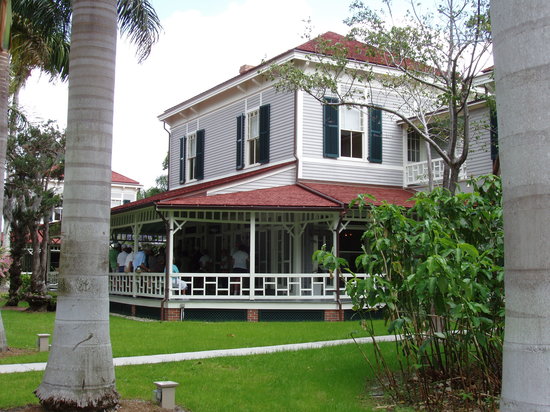
Ford Edison Estate courtesy of Tripadvisor.com


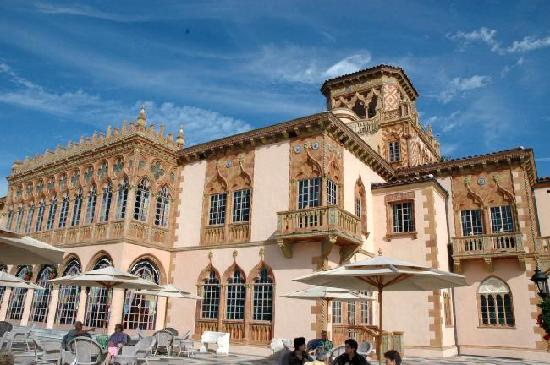
Whilst in Florida we travelled from beaches to cities, always with a museum or two in mind. Highlights for us were the Ringling Museum and the Ford Edison Country Estate.


Whilst visiting the Titusville Museum, run by a bunch of enthusiasts for their local history, I came across this lovely little second-hand bookshop and had a conversation with the owner about Deborah Harkness's new book. If you are near Titusville, do go check out the shop, The Book Rack, it has a great selection of Historical Fiction and Historical Romance.


Before signing off this post, I must mention fellow historical fiction bloggers who were on my panel at the conference; Circus drumroll please!

Julianne Douglas
Heather Webb
Heather Rieseck
Amy Bruno

I had a fabulous time in Florida, came back refreshed and renewed and itching to get back to my writing.

Friday, 14 June 2013

Blogging at the Historical Novel Society Conference, Florida

I will be speaking at the Conference on the panel entitled 
Virtual Salon: The Historical Fiction Blog
Today’s readers (and publishers) expect authors to have an internet presence. A blog is an effective way to join the writer, reader, and reviewer of historical fiction in dynamic interaction about novels and the history that infuses them. This panel at the conference will not only examine the benefits an author derives from maintaining a blog at various stages of her career, but will explore how blogging serves the historical fiction community as a whole. Topics include: finding a niche and establishing a voice; effective blogging strategies (regular features, guest posts, contests, blog tours); blogging etiquette; expanding one’s audience; and measuring success. 

I thought it would be nice to introduce you to my fellow-panellists on the 'Virtual Salon' panel at the Conference. We have only ever met 'virtually' so it will be lovely to meet them in real life. Click on their pictures to be taken to their blogs!

My PhotoJulianne Douglas has been organising us all for our panel discussion, and wrote the blurb at the top of this post. Julianne's blog 'Writing the Renaissance' focusses on historical fiction set in sixteenth century France. An avid reader who fell in love with all things French at the age of twelve, she went on to earn a Ph.D in French literature from Princeton.


Heather Webb's novel, 'Becoming Josephine' will be published in 2014 by Penguin/Plume and her blog 'Between the Sheets' is about her writing and publishing journey.


Amy Bruno's blog 'Passages to the Past' is a long-standing blog for the historical fiction community reviewing books of all periods and she boasts over 1000 followers and 418 networked blogs. Amy also runs the Historical Fiction Virtual Book Tours.


Heather Rieseck started her blog, 'The Maiden's Court' in 2009 as an outlet for her reading. It has since become well-known for its honest reviews of historical novels and her author interviews.


Please consider checking out the blogs and leaving a comment. If there is anything you would like to know about blogging and historical fiction, please leave me a comment so that I can flag it up for the panel. We are looking forward to a great discussion and look out for my report of the session on this blog.