

My latest novel in progress features a cast of real historical characters most of which have the real name 'Elizabeth.' My main character is not called Elizabeth, but her mother is, and her sister. Her aunts on her mother's and father's side are also called Elizabeth, as is her employer for whom she works as a lady's companion.
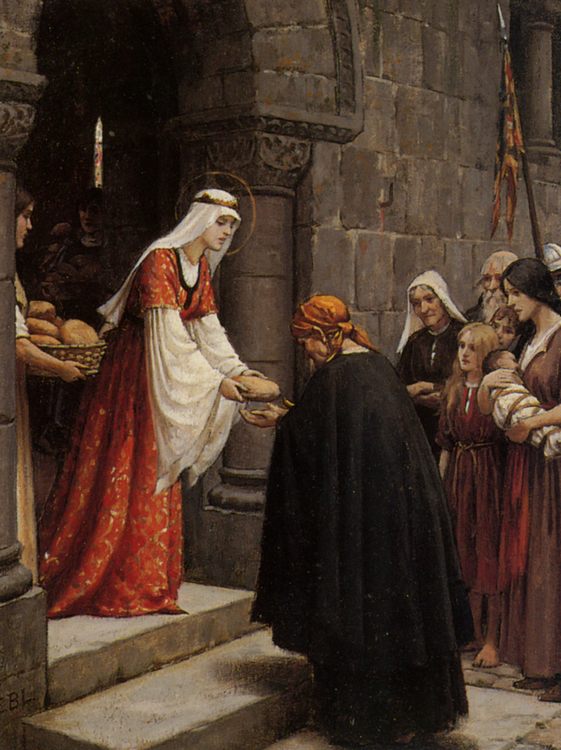 |
| The Charity of St Elizabeth Of Hungary Edmund Blair Leighton |
Here are a few more common abbreviations that were used in the 17th and 18th centuries: Bess, Bessie, Beth, Betsy, Betty, Elisa, Eliza, Ella, Ellie, Elsa, Elsie, Elyse, Libby, Liddy, Lydia, Lilian, Lilibet, Lilibeth, Lillia, Lillian, Lisa, Lise, Lizbeth, Lizette, Lizzie, Lizzy, Tetty.
I imagine the general population had exactly the same trouble in knowing who was who, and that's why all the diminutives sprang up. But to add to 'Elizabeth mania', and not content with the English version, the pesky name crept into English at this time as these exotic variants as well:
Isabella (Spanish), Lise (Danish), Isabelle (French), Lisa (Dutch), Liliana, (Hungarian), Elísabet (Icelandic), Eilish, (Irish), Elisabetta, Liana, (Italian), Belinha, (Portuguese), Elspet, Elspeth, Ishbel, Isobel, Lileas, Lilias, Lillias (Scottish) and Bethan or Bethany (Welsh).
Originally Elizabeth was the Greek form of the Hebrew name 'Elisheva' meaning 'my God is my oath'. The name appears in the Bible in two variants, but Elizabeth as a name was originally far more common in Eastern Europe where the twelfth century saint, Elizabeth of Hungary, made it fashionable. She was a wealthy princess, daughter of King Andrew II, who used her riches to help the poor. One day during Mass she placed her crown on the altar as a sign of renunciation and to symbolise her humility and poverty. In 1228, she renounced her position and the world entirely, and took vows as a Franciscan penitent.
 |
| Cate Blanchett as Elizabeth I |
In medieval England the name was occasionally used in honour of the saint, though the Spanish version, Isabel, was much more common, until of course England went to war with Spain. Then of course English parents preferred the version used by our own Queen Elizabeth I. The centuries following Elizabeth's reign led to a great flowering of Elizabeths, as parents wanted to bestow upon their girl children the health, wealth and wisdom of the deceased monarch. For centuries afterwards, during the Civil Wars and upheavals of the 17th century, Elizabeth's era was looked back upon as a Golden Age, and girls were named after her in the hope of her long life and good fortune - hence my problem!



