AddThis

Bookmark and Share
Showing posts with label National Trust. Show all posts

Friday, 23 January 2015

The Historic House Locations for Wolf Hall


Scene with Anne Boleyn, Wolf Hall

A copy of my National Trust Magazine arrived yesterday and there is an article which details the locations used in the series Wolf Hall. I really loved the first episode, but my NT magazine did not have room for all the properties that will be featured apart from Montacute House. So here, without further ado, are a few images to whet your appetite. If you love historic houses like I do, I strongly recommend that you join the National Trust - free entry to most of these stunning locations. Click on the pictures to get to the National Trust sites for more stunning pictures.
Laycock Abbey was also used for the filming of the Harry Potter films, and was originally an Abbey and a Nunnery. It is now also home to The Fox Talbot Museum of Photography.

Great Chalfield Manor is a Medieval Manor House with a beautiful garden with lily pond and summerhouse.
Chastleton House is an impressive Jacobean Manor House built in 1607.
Horton Court in Gloucestershire was originally built in Norman times, but is now a small manor house.
More details about each house can also be found here.

Montacute House, picture from Wikipedia


Laycock Abbey

Chalfield Manor


Chastleton House


Horton Court


Horton Court
I'm looking forward to seeing the rest of the series and seeing these stunning locations. I'm also eagerly awaiting Mantel's next book, though according to the BBC she has told us all to 'be patient'. The pressure on her must be enormous, and they are very big books. Wonder if she'll be the first Triple Booker Winner?!

Monday, 23 September 2013

Sizergh Castle, Cumbria - ghosts and old glories #EHFA

In order to celebrate the launch of Castles, Customs and Kings I'm taking part in a "blog hop" . You can go to English Historical Fiction Authors blog to enter for a chance to win a free copy!

I am also giving away a brand new signed paperback copy or ebook of my 'not-quite-released-yet' novel - A Divided Inheritance! Book will be shipped as soon as it is available, launch date 23 October. Comment under the post to enter. Extra entry if you join the blog. Don't forget to leave an email address. Draw closes midnight 29th September.

The name Sizergh dates from the 9th century and was originally spelled  sigaritherge, meaning Sigarith's pasture (sigarith is a female name.)

The castle has been home to the Strickland family for many generations, beginning in the 12th century, and is still lived in by them today. During the Wars of the Roses the family were Yorkists, and in the succeeding generation were linked with the Parres of Kendal - the family of Catherine Parr, wife of Henry VIII.


The photos above and  below are from an article on the castle by Matthew Penmott, and I can heartily recommend his site on the Castles of Cumbria.
The Strickland Arms in the Parish Church, Kendal
Sizergh Castle consists of a Pele tower dating from the 14th century, which gave protection against scottish raiders. On the courtyard front is the Strickland Coat of Arms. The main entrance leads today into a Tudor Great Hall, which has since been adapted by different generations of the family into a series of smaller rooms. An Elizabethan corner block and wings enclose a courtyard, and on three sides of the castle the remains of a moat is discernible.

The Return of the Inlaid Chamber
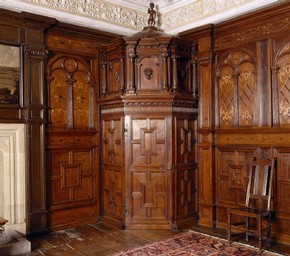
In 1891 the ornate panelling from the Inlaid Chamber, along with various furnishings, was sold to keep the house maintained. Thanks to the Victorian and Albert Museum, the original panelling and stained glass which was tailor-made for this room at Sizergh has now returned home to the castle after more than a century in London, and is now on permanent loan. (Pictures from the V&A)


Inlaid Room at Sizergh Castle, © National Trust Images/Andreas von Einsiedel


The beautifully wrought panels were inlaid with English Poplar and “Bog” Oak to create a three dimensional effect of geometric and strapwork motifs.


Ghost of the Starved Lady
In the Pele tower ghostly sobs denote the presence of  a lady whose husband, before a raid by the Scots, was locked away in a room with an impregnable door - presumably to keep her safe. But her husband died and the terrified servants abandoned the place. The poor wife starved, and as she tried to claw her way out she went slowly mad. Her screams still haunt Sizergh on dark and spooky nights......

brown-lady

More photos of ghosts can be found at http://www.strangerdimensions.com/2013/07/11/top-10-famous-ghost-pictures-and-the-stories-behind-them/

Apart from the attraction of the ghost, Sizergh Castle is managed by the National Trust and is well worth a visit - beautiful grounds and gardens too, along with more than a thousand years of history!