AddThis

Bookmark and Share
Showing posts with label novel. Show all posts

Friday, 6 February 2015

Page-turning fiction - can it be memorable?

I've just finished a book I've been working on for about eighteen months, and now I am catching up with my reading.
As writers we are encouraged to hook the reader by encouraging them not to pause, but to keep on turning the pages. But - one thing I have noticed is that the more tension there is in the plot, and the faster the pages are turning, the less specific detail I absorb, and the less memorable a scene actually becomes. This means that often the climax, the supposed highlight of the whole book, goes by with barely much attention from the reader.
61hiH7Mks-L._SY344_BO1,204,203,200_I was recently reading The Miniaturist by Jessie Burton. I can remember with great pleasure the early scenes, the loving description of the new house where the new wife is to live and its bizarre and expensive counterpart, the miniature house. But once I am concerned about the life or death of Nella's husband I am too busy flipping the pages to sink deep into the words, and although the early part of the book was memorable for me, the latter part was much less so.
Plausibility is also an issue here, because real life is not so frenzied. The passages in my own writing where the pages are turning, are also the ones most likely to be in need of a reality check. So I recognise Ms Burton's problem. Thrillers are not renowned for being memorable because a thriller writer has this juggling act all the time - the more unlikely the plot, the more the writer must convince  the reader by supplying a slew of specifics, explanatory detail, incontrovertible data. But the same is also true of any other novel, including my own genre of historical fiction.
A good novel perhaps should allow the reader passages where the reader must slow and think, and drink in the words, but also produce enough pace to keep readers motivated to carry on. Many novels that have stayed with me are very long. This could be because the length allows depth, and a long novel can have multiple high-points, and corresponding multiple episodes of deepening, where we can take on more detail.
download (1)What do you think? And is this a balance that is easy to achieve? A book that does this perfectly, to my mind, is The Book Thief by Marcus Zusak. Page-turning, and memorable.

Monday, 30 June 2014

Historical Fiction - the problem of too many Elizabeths


My latest novel in progress features a cast of real historical characters most of which have the real name 'Elizabeth.' My main character is not called Elizabeth, but her mother is, and her sister. Her aunts on her mother's and father's side are also called Elizabeth, as is her employer for whom she works as a lady's companion.
The Charity of Saint Elizabeth of Hungary :: Edmund Blair Leighton - History painting ôîòî
The Charity of St Elizabeth Of Hungary
Edmund Blair Leighton 
This is a real problem for historical novelists who are stuck with a cast of characters who all have the same name. I have taken the obvious way out which is to call them all by variants - so we have Aunt Beth, Aunt Eliza, Liddy, and yes, you've guessed it, Elisabeth (but spelled with an 's'.) Oh, and 'Mama' (who is also an Elizabeth, but I try to avoid using her actual name!)

Here are a few more common abbreviations that were used in the 17th and 18th centuries: Bess, Bessie, Beth, Betsy, Betty, Elisa, Eliza, Ella, Ellie, Elsa, Elsie, Elyse, Libby, Liddy, Lydia, Lilian, Lilibet, Lilibeth, Lillia, Lillian, Lisa, Lise, Lizbeth, Lizette, Lizzie, Lizzy, Tetty.

I imagine the general population had exactly the same trouble in knowing who was who, and that's why all the diminutives sprang up. But to add to 'Elizabeth mania', and not content with the English version, the pesky name crept into English at this time as these exotic variants as well:
Isabella (Spanish), Lise (Danish), Isabelle (French), Lisa (Dutch), Liliana, (Hungarian), Elísabet (Icelandic), Eilish, (Irish), Elisabetta,  Liana, (Italian), Belinha, (Portuguese), Elspet, Elspeth, Ishbel, Isobel, Lileas, Lilias, Lillias (Scottish) and Bethan or Bethany (Welsh).

Originally Elizabeth was the Greek form of the Hebrew name 'Elisheva' meaning 'my God is my oath'. The name appears in the Bible in two variants, but Elizabeth as a name was originally far more common in Eastern Europe where the twelfth century saint, Elizabeth of Hungary, made it fashionable. She was a wealthy princess, daughter of King Andrew II, who used her riches to help the poor. One day during Mass she placed her crown on the altar as a sign of renunciation and to symbolise her humility and poverty. In 1228, she renounced her position and the world entirely, and took vows as a Franciscan penitent.

Cate Blanchett as Elizabeth I
In medieval England the name was occasionally used in honour of the saint, though the Spanish version, Isabel, was much more common, until of course England went to war with Spain. Then of course English parents preferred the version used by our own Queen Elizabeth I. The centuries following Elizabeth's reign led to a great flowering of Elizabeths, as parents wanted to bestow upon their girl children the health, wealth and wisdom of the deceased monarch. For centuries afterwards, during the Civil Wars and upheavals of the 17th century, Elizabeth's era was looked back upon as a Golden Age, and girls were named after her in the hope of her long life and good fortune - hence my problem!

Sunday, 18 May 2014

No Quick Fix - The Inherent Complexity of a Novel

Recently I have noticed that there has been a tsunami of 'How to' writing guides published, and that these are selling extremely well. In fact it is probably more profitable, and perhaps easier, to write a book about writing a novel than it is to write a successful novel.

In fact that must be so - because so many people are turning to these books for help.
The titles are designed to make it sound easy:  Fix your Plot in Five Seconds Flat! Be a Billionaire Bestseller in 30 Days! Secrets of Fail-safe Story Structures!

wedding speech help
These books are designed to make it sound easy because that's what every novelist wants - an easy way to do this thing called writing a novel.
But the reality is that good novels are complex, intricate, difficult things, and just like life, a formula is not necessarily what creates a great novel, particularly for historical novelists who have to juggle the reality of real historical events alongside any story structure. It is a slightly more thorny task  to suddenly 'create' a worthy antagonist if the real history does not provide one. We cannot turn real characters into easily categorized roles in our novels, so have to work hard to fit our stories easily into conventional models, turning instead to internal motivations to create opposing forces.

It is not true, however, to say that good story structure has to be thrown out of the window, and that none of these books on writing have anything to offer. On the contrary, I'm a big fan of books on writing. But reading the book is often not the same as editing something with multiple timelines, events that must take place on certain days, or characters who are known to be a certain way because of genuine evidence. Such a journey is more like negotiating a maze of corridors with light somewhere at the end of the tunnel, but not necessarily where you thought the exit was.

I would argue that good novels are complex, that they weave a number of interlocking themes, ideas and plots. When working on a novel the urge to get it finished by an easy solution can be overwhelming, but rather than looking for a 'quick fix' it is often better to sit with the complexities, let them simmer and brew, making your novel that much richer and subtler in the process. Anyone will find it easy to apply story structure to a novel after it is finished - to point out the mid-point, the hook etc etc. But the simple structures may have been a lot less easy to spot whilst the novel was in progress, and too often in desperation to see our novels finished, we want to fix them too early, before they have had a chance to breathe.

In order to sell books, it is argued, we must be more productive, to build our readership more quickly. This can induce a panic (and a vague sense of being bullied) to produce more and more books, but does not necessarily mean that the books are better. A readership is not built on bad books. I would argue that like wine, a good novel needs to be matured. A book like Shantaram or The Far Pavilions both at nearly 1000 pages long, (yes, 1000 pages!) surely cannot be produced quickly. The Pillars of the Earth, by Ken Follett, a historical novel about the time of the building of cathedrals in England, took about 10 years to write, but has stayed popular with readers ever since.


For those of you who still would like a quick fix (I can't convince you, can I?) then I heartily recommend 'How not to write a novel' by Sandra Newman and Howard Mittelmark, which not only avoids telling you what to do, but shows you what NOT to do through a series of hilarious but cleverly-constructed 'bad writing' examples. When you are feeling like you need a quick fix, pick this up instead and sift through your novel for similar cringeworthy examples. Total gold.


Friday, 13 September 2013

Robin Hood - the anti-hero for today as discovered by Lauren Johnson


Today I'm welcoming Lauren Johnson to talk about her new debut, The Arrow of Sherwood. I have always been fascinated by Robin Hood, so I asked Lauren -

Why do you think the legend of Robin Hood has been so enduring?

Lauren : I think Robin endures because he is an antihero – throughout his history, from at least the fifteenth century, he has been a symbol of misrule, of chaos, sometimes of outright violence and lawbreaking. His connection with Mayday in the past is a clear sign of that, because May was all about raucous celebration and upsetting the norm. But he is also a very modern hero. You can see that in the Robin Hood tax campaign – we still want a figure who stands up for the poor and needy, against the seemingly all-powerful wrongdoer. In all our modern TV detective shows, the main character could almost be Robin Hood – they do what they have to, to bring down the bad guy, even if it means bending the rules. He’s mischievous, but he stands for something, and that’s really appealing.

What will surprise the reader about your version of the character of Robin Hood, and will we be meeting Maid Marian?


In The Arrow of Sherwood you will meet pretty much all the archetypes of the Robin Hood story, but probably not in the way you expect. At the start of the book Robin comes back from crusade – he was sent on it to do penance – and the first person he meets is called Marian Peverill. They are supposed to get married, in one of the usual noble arranged marriages, but they deeply dislike each other. There is no respect between them whatsoever. That scene was one of the first I had in my mind – these two famous romantic characters appearing, and they can barely tolerate being in the same courtyard.

I wanted to make Robin, like all the characters, just a bit more human than in lots of versions of his story. He has grown up as a lord’s son but he feels constrained by his family and spent lots of his youth around lowborn men – there’s a bit of a Henry V element to him in that respect. But returning from crusade he is supposed to give up his ties to the common friends he had, and properly become a lord, ruling over them, focusing on increasing his estate and keeping the law. So a lot of the book is about that struggle: between being the lord his family want him to be, and his instinct to help his old friends. Not just because he feels that some other lords are abusing their power and he ought to stop it, but also because there is that danger-seeking element to him that enjoys transgressing rules.

You work as a costumed interpreter, can you explain what this is and how this helps your understanding of history?


Costumed interpretation – sometimes called live or historical interpretation – is a combination of dramatic performance, historical presentation and one-on-one conversation, usually in heritage settings. At its simplest, it means I wear a costume and engage with the public as a character from the past. I have been very lucky to work in a wide range of time periods, portraying very different – but always interesting – characters. I’ve played everyone from medieval princesses to Victorian scullery maids.

I think my experience as a costumed interpreter has helped me massively, not only in my understanding of the past but in my story telling. As part of my research I often go beyond reading about historical events and my character to learn songs, dances, social behaviours, contemporary stories – some of which are pretty weird – and that means I get a really rounded view of the past. Then, having done my own research I have to impart that knowledge to members of the public, from toddlers who might just want to know about medieval animals or my crown, to hyper-informed professors in their 60s. You get very good at gauging what interests the public and the best way of getting your information across.

And then there is simply the fact that I’ve been in the really privileged position of running up and down castle stairs in flat leather shoes, felt how you move in a laced gown with really long beautiful sleeves that can trip you up, sat in a medieval great hall and watched recreated court cases or stories being told – I’ve even shot a trebuchet in my time and withstood a siege from the castle walls. (Not literally, I hasten to add.) When you have the physical experience of a period of history and you’re engaging with your character, you get very close to feeling like you are back in that era, and I think it helps you understand their behaviour.

How important is the real-life history to your re-telling of the story and what is the favourite source you have used?

For me, the real-life history is very important. Obviously, I’ve written a story about a man who almost certainly didn’t exist in the way his myth is now remembered. But I very much wanted to root my version of Robin Hood in a real world – a period that I had spent a number of years researching and interpreting.

I came at this story with a clear question in my mind. A lot of the popular mythology of Robin Hood has ossified over the years – we think of him being a nobleman who lives in the forest with his common friends and Maid Marian, who helps King Richard against evil Prince John and steals from the rich to help the poor. But that character doesn’t really make sense in the twelfth century, when Richard and John existed. Noblemen were usually very separate from the people on their land, and you didn’t get noblewomen hanging out in forests with paupers. So my question was: If a nobleman called Robin of Locksley had existed in that era, how might he have become the Robin Hood we recognise today? I wanted to fuse the historical fact with that myth.

In terms of research, my favourite sources are contemporary ones that bring the past to life. I love twelfth century stories – Marie de France, Chrétien de Troyes, the moral fables. And I really like visual sources. I would love to take more time to just sit and look at manuscript images, because they are extraordinary, and they reveal so much about medieval life and their sense of humour. It’s a later document than my story is set but the Luttrell Psalter of about 1320-40 is brilliant from that perspective – it’s full of scenes of medieval noble life, like the lady sending her husband off to war and handing him his armour, or feasts being served at great tables, or royal ladies on the move, with an absurdly long wagon and all their servants and animals. Those sources bring the past to life, and make your realise that they were still human beings – it bridges the gap between us and them, and that is always what I want to do in my work.

Thanks Lauren, I've loved talking to you - and all the best with The Arrow of Sherwood.

You can follow Lauren on Twitter @History_Lauren or visit her website at http://laurenjohnson1.wordpress.com

Thursday, 6 June 2013

Four books on writing that go beyond the basics

Like all writers, I love my craft. Many writing books are aimed at beginners and often give more experienced writers the same information re-packaged. As a writer who is already published you might think that I don't need to read any 'how to' books about writing, but actually the more I write the more interested I get in the subtle nuts and bolts of how storytelling works, and the more I admire other writers who do it differently.

If like me, you want to increase the subtlety in your work then I can recommend the following books. None of them is written by a writer I know, and none of them is about how to write a bestseller.  What are your favourite books on writing? I'd love you to leave me a comment! 

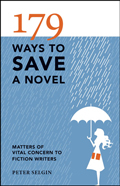
179 ways to save a novel 

Matters of Vital concern to Fiction writers 
by Peter Selgin
The ideas in this book are grouped under six headings: Substance; Structure; Style; Symbol, Myth & Metaphor; Soul and Other Matters.


Self Editing for Fiction writers
How to edit yourself into print 
by Renni Browne and Dave King
This book has great examples and also wonderful cartoons, although it does cover ground that will be familiar to most, such as 'show not tell'. I include it because it is the best basic book on editing I have ever found, and the instructions are really clear.

Front Cover

Between the Lines
Master the subtle Elements of Fiction writing 
by Jessica Morrell
Few books attempt to explore subtleties of tone and voice. This book does just this. Most of the examples given are from the US and this can be off-putting if you are a Brit, but it is still a book well-worth reading.


The Art of Fiction 
Illustrated from classic and Modern texts 
by David Lodge
A series of articles from The Independent on Sunday, this book covers such things as 'the intrusive author', 'intertextuality' and 'defamiliarization' using examples as diverse as Charlotte Bronte and Michael Frayn. It is a book of literary criticism from which writers can learn a lot, although it is not strictly speaking a 'how to' book. The examples in this book show just how far you can go as a writer to make your voice your own.

Friday, 6 April 2012

The Language of Flowers - Vanessa Diffenbaugh

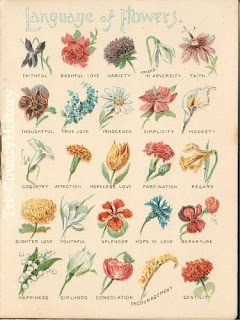
Common in the 19th century, the idea that flowers had symbolic meanings led people to convey their emotions through the gifts of the flowers they gave one another. Known as the art of "floriography", these symbolic bouquets became popular, and the posies were known as "tussie-mussies" in Victorian times. Today you can find more about the meanings of individual flowers from The Gardener

This Image comes from Joyce Tice's website


The Language of Flowers tells the story of Victoria, a homeless eighteen year old and her passion for the meanings of flowers.


Victoria has been brought up in foster care, and the only adult with whom she had a meaningful relationship was Elizabeth, the woman who first introduced her to the language of flowers. Because of a catastrophe for which Victoria herself is to blame (I won't spoil it for you) they have become estranged, and now Victoria is living rough. Desperate for work, she ends up in a florist's shop where her gifts with ascribing meaning to flowers are appreciated at last.

But life is not that simple, and Grant, an acquaintance from the past turns up.From there, things grow more complicated, and after they begin a relationship, Victoria becomes pregnant. Through a series of flashbacks the reader begins to understand what happened during Victoria's childhood to make her so distrustful of herself and others.

This book has been available for a while and has won awards. I imagine by now it is a book club classic, because I thoroughly enjoyed it. It is a well-written and absorbing read. You can watch Vanessa talk about writing her novel here

Here is my floral review, taken from the dictionary at the back of the novel.

 Lisianthus - appreciation
Rose, orange - fascination
Sweet Pea - delicate pleasures


Wednesday, 18 January 2012

Bringing your inner artist to heel - the long haul

Last week I read a great article in the Guardian called "unleash your inner artist" in which well-respected artists from different disciplines told the reader what inspired them. Each had ideas for setting the right conditions, and they varied from "Find a studio with more than one window" to "go on a journey with someone who is as different from you as chalk from cheese".

As a writer I have no trouble at all finding inspiration. I could start twenty books tomorrow. But the question is, could I sustain them? Never mind unleashing the inner artist, how do I bring it to heel?

For novelists, most of their work of their first draft happens in the middle of the book. For me the pattern looks a little like this:

Inspiration! (The beginning! I write feverishly.)
Hard graft,
H a r d G r a f t,
H a r d   G r a f t,
H   a  r  d    G  r  a  f  t,
H     a    r    d    G    r    a    f    t
Aha! The End is in sight.
The End - breathes a sigh of relief.

So a lot of the trick of it is about keeping inspired through the long middle. The characters or subject must have viability for the long haul, and be fascinating enough to sustain my interest over the eighteen months it takes me to research and write the book.

One of the best quotes in the Guardian article was from Guy Garvey, singer/guitarist with Elbow, who quoted in turn some advice he'd been given by songwriter Mano McLaughlin.


"The song is all, he said. Don't worry about what the music sounds like; you have a responsibility to the song. I found that really inspiring: it reminded me not to worry about whether a song sounds cool or fits with everything we've done before - but just to let the song be what it is."

When I start out I have an idea of what the book will be.As I approach the middle I realise that the book is moving away from my vision of it. I try to bring it back. It persists in going its own way. Much of the hard graft in the middle of the book is about the battle between my control of the story and my imagination which wants to take a looser journey.Somewhere near the end of the hard graft phase I realise I have to "let the song be what it is" and allow the story that wants to be told to have free rein. Just about then, I glimpse the end.

Subsequent drafts are about letting go of previous rigid ideas that I had about what my book might be, and who I might be as a writer. I have had to let go of ideas that I might be a) as brillliant and respected as Hilary Mantel b) as popular and best-selling as Dan Brown c) about to be tipped as the next TV book club read, or d) the ground-breaking quirky new voice of the 21st century.

You might have to do the same. Maybe you thought it was literary fiction, until you found you had written a fast-moving convoluted thriller with a crazed psychopath. Maybe you thought you would like to write a romance, until you found it impossible to force those love scenes and ended up with a murder instead.Maybe you became so interested in the motivations of your central couple that the plot never happened and it became a meditation instead and you found you had written a literary novella.

I write historical fiction so here are my top tips for inspiring myself in the long haul.
Surprise, surprise, they all involve leaving the computer and going out, and none of them are hard-line research. They are what I call "dabbling."

Browse your subject in a second-hand bookshop.Don't rush, allow lots of time for diversions.


Wander round a place your character might have lived.


Look up his/her name on Ancestry.com and find out what his/her namesakes did


Go horse-riding. (In my books most people travel by horse)


Go to an Antique shop, auction or museum and handle objects from the period.


Find a spot to daydream about your book and make a point of allowing time for the mind to drift.


Let the song be what it is.