AddThis

Bookmark and Share
Showing posts with label editing. Show all posts

Sunday, 7 June 2015

UK Independent Publishers - a 'Do they add value?' check


Stack-of-Books-1024x682

I meet regularly with other novelists to critique our works in progress, drink tea, and discuss the various merits of the biscuits. Recently at one of my novelists group meetings we were discussing independent publishers who might publish a full length novel. I argued that there were not that many, but one of the other group members recently emailed me to say that the Independent Publishers Guild UK (www.ipg.uk.com) have a staggering 580 members!  

So why do I say there are not that many ?

The answer is, because in my opinion very few add value for a novelist, and some add so little value that they are in fact proxy self-publishing. 

There are of course loads of independent publishers that publish everything from memoirs to military to experimental.(eg local-to-me Cicerone Press that publishes mountaineering guides) And a lot of other so-called 'independent' publishers that are actually assisted self-publishing companies e.g. the well-respected Troubadour, Silverwood. (But these self-publishing services will cost you - and rightly so, for the various services they offer.)

But in fact there are very few independents that publish full length novels, don't charge the author anything at all, and do add value.

These days most publishers of  fiction offer e-books as a matter of course, (and some only e-books) so lets assume that as a given, that they will at least upload your book to Amazon. Publishing is easy these days, so publishers have to do more than just upload an ebook and offer a badly-designed POD paperback to win my vote.

So what exactly do I mean by 'add value?'

PHYSICAL VALUE
 
a) Offer distribution of physical books to bookshops (ie I don't have to carry my books to my local bookseller myself)

b) Offer proper editing, proof-reading, interior layout and typesetting (i.e not just an edit through an online programme such as Autocrit, or reproducing your Word Document as a book)

c) Offer a print run (however limited) that is not just Print on Demand such as CreateSpace. By the time the publisher adds their cut, it makes the books too expensive in comparison with other traditional publishers, and therefore they fail to sell. Who will buy a £12.99 paperback when similar titles sell for £7.99?

d) Offer an individual marketing strategy for your book, including promoting it to bookshops and libraries, in other words not just bunging it on their website and newsletter and hoping for the best.
 
I reckon many  independent publishers fail on one or more of those counts. They rely on you to sell your books to family, friends and your network, and then take royalties for the very little effort they have put in, which usually just involves adding a cheaply-designed cover and uploading your word document as a book to kindle, POD and their website. I admit these things take time, and incur costs for the publisher. But in most cases you would be better off self-publishing than giving this type of publisher a substantial part of your royalties when they add so little value to what is in the end your product.


There are many 'independent' publishers that look convincing, but are actually not that good for the author. Eg take a look at this fairly typical independent publisher  It looks great, until you read under their submissions guidelines: 'Depending on how many we think it could sell, we offer varying levels of contract. About one in ten of the titles on the list have a subsidy from the author, directed either towards more editorial or marketing work than we can normally provide.' Non-fiction sells well, so perhaps 1 in ten is actually most of the fiction, but of course you wouldn't know that if you were the submitting author.

or this one: 'A traditional partnership agreement entails the same benefits as a mainstream agreement. However, as the writer you may be asked to cover part of the cost of publishing the book. We follow all traditional industry etiquettes with regards to the promotion and marketing of the title in addition to all other avenues involved in the process.'

From another niche Independent Publisher website: 'We believe that as an author it is your responsibility to ensure that your work is of a reasonable standard before submitting to us. We can recommend a proof editor if you wish but that would be outside of our arrangement with you and you would contract them yourself.'

If you are going to pay, why not self-publish or use openly assisted self-publishing like Silverwood Books?

editing-224x300

PSYCHOLOGICAL VALUE

Of course I am not negating the psychological value of having your work accepted by a publisher. After receiving a lot of rejections (and we all get them!) it feels brilliant to have your book accepted by somebody. Anybody!  A friend of mine recently had her novel accepted by a small independent publisher. She was over the moon until she read on Link'd In that her commissioning editor had just left school, had never worked in publishing before, but had done  two weeks work experience for a book promotion company. So if literary validation is important to you, don't forget to Google who is reading your manuscript and whether they are actually more qualified to make a judgement on your work than your local newsagent.

However, there can certainly be psychological (and monetary) value  in accessing a like-minded community. If you have a book that suits a niche audience, then there can be value in a niche publisher and in becoming part of that network, but check the network is not just other hopeful authors like yourself.

a) See if the books from that publisher have won any prizes or been nominated for an award (or sold millions - we wish!)

b) Check whether any of the books been endorsed by writers or critics you have actually heard of, not just 'Brilliant' - Amazon Reviewer

b) For niche markets, eg horror, fantasy, experimental, check that the publisher seems to have good networking links with their community. Eg Do they blog? If so, check out their blog.

CONVENIENCE VALUE
OK, so you are technologically inept, and it's much easier to hand it to a publisher and let them do it, if they accept your submission. But if it doesn't get edited or properly laid out, if it has a bad cover, if it only reaches a few other writers who go to their website, and if it is too expensive to be attractive in bookshops, the convenience soon becomes inconvenient. You haven't the control to do anything about it, the way you would have had if you had self published - and you are still paying them via your royalties.

However, for full length commercial/literary novels I can safely say the following independent print publishers do add value - not an exhaustive list, and in no particular order. They all have beautiful websites and beautiful books that you sometimes see in bookshops - a good sign.

Bloomsbury*, AlmaMyrmidon, Honno Press, Parthian Books, Myriad Editions, Allison and Busby*, Serpent's Tail, Valley Press, Canongate*, Legend, Salt, Cinnamon Press, Accent Press, Cillian Press.

Some of these require you have an agent right now to submit (those marked with asterisks), some don't, but for a bigger list of  small independent publishers check out Nottingham Writers Studio. If you want to see a list of other small presses, check out Lollipop. And here's a complete list of UK publishers competing in The People's Book Prize.

Anyone who can recommend more excellent independent publishers to add to this list - please do!

Thank you to crime noir writer Tess Makovesky for prompting this post. Find her at www.tessmakovesky.com

Wednesday, 20 May 2015

Editing historical fiction, my way

I am in the middle of edits for two of my books, one a young adult novel and one a 400 page adult novel. These are the edits I make before I send out to my agent, a publisher, or in some cases the public. There will be other edits later, but as some publishing houses edit very heavily, some hardly at all, it pays to be picky with your work.

Recently I have seen a plethora of writing books suggesting that you should edit in 'one pass'.

This does not work for me because of the amount of research I need to check. So here is my editing process. It takes as long as the actual writing of the book.

Editing

I always work with a printed copy of the manuscript, and initially I am editing for story. 
I read like a reader and not a writer, to identify  whether the nuts and bolts of the story work. At its heart, story is about change, so if it's getting static, alarm bells ring. I mark parts that are slow or boring with a big red pen. Though sometimes boring does not mean cutting stuff, but adding more detail to make it interesting and bring it to life. 

Usually the first time I print out the draft it needs a lot of re-working -  new chunks need to be written and others lopped off. At this stage I do extensive re-writes. That copy is then like an old rag covered in scribble and crossings out and is re-cycled onto our log-burner!

After more work on the computer to streamline the story, I'm ready for a more detailed edit. Usually I send this newer version out to some readers so I can incorporate their comments when I work on the next edit. One way of speeding it up is to mark all the pages that need edits with sticky post-its. I use the same manuscript and just go through it with different colours for each editing pass. Then with the copy next to me with its rainbow fringe, I trawl through the manuscript a page at a time making all the necessary alterations. At this point I am usually fuelled by coffee, a looming deadline, and a desperation to get it finished and move onto the next book.

Coffee
Here are the passes I make:
  • edit for character. Go through each major character's arc of action and emotion. Check what they are doing in the scenes where they are absent, and try to refer to these actions in the scenes where they are present. Get a sense of their daily routine - for example how long it takes them to dress, their relationship with servants or 'betters', and their class in relation to other characters. Check how they are feeling;  that it is consistent, and that it has development.  Make sure their attitudes are consistent with the period.
  • edit for theme. Highlight any themes that drive the novel, make sure sub-plots echo these themes. Look for metaphor, symbol and meaning. Try to find parallels with today, and highlight  them. They will be useful when you have to promote or tell people about your book.
  • edit for time-scale. In historical fiction it is particularly important to get dates right, and for the narrative to fit within certain fixed parameters or historical milestones. Check travelling times - horseback and boat are very slow, but mail can be surprisingly quick.
  • edit like the most eagle-eyed historian. I have made small errors in my books, (really sorry ) but not because I did not care - I did my best to make the history right! Often it is little things (like the taking for granted of walls and hedges before the enclosures act) that catch you out. Question everything and double check your research. Keep notes in case someone queries your sources. Make notes about where you have changed, bent, or ignored  supposedly 'known facts', and why. Two books down the line you might not remember why, but an expert reading your book is bound to write to you and ask.
  • edit for anachronistic dialogue, and for dialogue that fits the character. It is easy to slip into modernism in dialogue, and the quickest way to lose your historical atmosphere. Seemingly innocuous phrases like 'Oh my God' have taken on a distinctly teenage flavour since OMG!
  • edit for good English - cut out uninteresting language, spelling mistakes, faulty grammar and typos, or get someone else to proofread it.
My novel grows about 10% during this edit as I re-work dialogue, fill plot loopholes and deepen character.
What is your editing process? Do you have any tips or tricks?


Thursday, 6 June 2013

Four books on writing that go beyond the basics

Like all writers, I love my craft. Many writing books are aimed at beginners and often give more experienced writers the same information re-packaged. As a writer who is already published you might think that I don't need to read any 'how to' books about writing, but actually the more I write the more interested I get in the subtle nuts and bolts of how storytelling works, and the more I admire other writers who do it differently.

If like me, you want to increase the subtlety in your work then I can recommend the following books. None of them is written by a writer I know, and none of them is about how to write a bestseller.  What are your favourite books on writing? I'd love you to leave me a comment! 

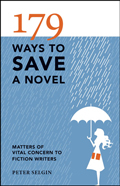
179 ways to save a novel 

Matters of Vital concern to Fiction writers 
by Peter Selgin
The ideas in this book are grouped under six headings: Substance; Structure; Style; Symbol, Myth & Metaphor; Soul and Other Matters.


Self Editing for Fiction writers
How to edit yourself into print 
by Renni Browne and Dave King
This book has great examples and also wonderful cartoons, although it does cover ground that will be familiar to most, such as 'show not tell'. I include it because it is the best basic book on editing I have ever found, and the instructions are really clear.

Front Cover

Between the Lines
Master the subtle Elements of Fiction writing 
by Jessica Morrell
Few books attempt to explore subtleties of tone and voice. This book does just this. Most of the examples given are from the US and this can be off-putting if you are a Brit, but it is still a book well-worth reading.


The Art of Fiction 
Illustrated from classic and Modern texts 
by David Lodge
A series of articles from The Independent on Sunday, this book covers such things as 'the intrusive author', 'intertextuality' and 'defamiliarization' using examples as diverse as Charlotte Bronte and Michael Frayn. It is a book of literary criticism from which writers can learn a lot, although it is not strictly speaking a 'how to' book. The examples in this book show just how far you can go as a writer to make your voice your own.

Tuesday, 16 April 2013

Novelists - how to use MS Word as a powerful editing tool

US author Maria Grace mentioned on facebook about using MS Word as an editing tool. I was intrigued so I asked her to come on the blog and tell us all about it. Over to Maria!

Thanks so much for hosting me Deborah. I’m so excited to get to talk a little about the bones of the writing process. I don’t get to do that very often.

When it comes to writing, I have no qualms about saying that line editing is my least favorite stage of the writing process. It is fiddly, nit-picky and just not a whole lot of fun. This of course means that I want to find the quickest, most efficient way of doing it in as few passes as possible and with tools that I already have.

So I did what all good writers do in such circumstances, I started researching. I read hundreds of articles on the art of line editing—making beautiful sentences that really work. I read about all sorts of expensive software to help the process. Then I read about features in MS word and realized I could get Word to do a lot of those fancy tricks with only a few steps. I found it so helpful, I would love to share my process with you. 


When I get in line editing mode, it is more than anything else, a search and destroy function. I search out problems in the prose and rewrite them. Rewriting is the easy part, finding the spots that need work is the challenge. Using the notes I complied from the reams of writing articles I have read, I created lists of words that signal problems. I organized those lists into three groups: words that signal sloppy or wordy constructions, words that signal point of view problems, and gesturing words that tend to get overused. I use Word’s built in functions to find all the words on one list, correct those issues, then go on to the second and third list. 

The function I use is the ‘replace all function.’ You can set it up to find specific words and replace them with a highlighted version of the same word. This will flag all the problems words, and if you add a touch of color coding to it, even signal what the likely problem is. Then, as you go in to do the actual editing, you can spot exactly what you need to do to fix it all. 

The basic process is simple. 
(Scroll down the blog for the pictures which are at the end of the instructions - sorry, blogger is just not co-operating to let me insert them in the text today - Deborah)

1. Go into word and set the highlight function to a specific color. I start with yellow.(picture 1). I use 7-8 colors on each pass, each one for a different purpose. More on that bit later.

2. Then select ‘Replace’ from the far right menu on the ‘home’ tab in word. If you’re using an older version it is in the dropdown menu. (picture 2). For our first example, we’re going to search for present participles which end in –ing. So type ‘ing’ in the ‘Find what’ field and tick the ‘match suffix’ box in the right hand column.

3. In the ‘replace with’ box, type ‘ing’ just like you did in the ‘find what’ box. Then go to the very bottom and click the left hand button that says ‘more’. (picture 3) Select ‘highlight’. Your box will look like this: (picture 4). Click ‘replace all’, the third box under the ‘replace with’ field.

4. Your file will now look something like this: ( picture 5) All the suffix instances of ‘ing’ are highlighted and you can quickly identify all the present participle phrases that need to be axed. Keep in mind that there are legitimate uses of ‘ing’ words that you want to keep, so you will need to read to determine what you need to do. BUT, this makes finding those trouble spots quick and easy.

5. To take this to the next level, I will go to town and find multiple problem cases at once and handle a whole batch of corrections in a single editing pass. To do this, keep the ‘replace’ window open and go back to step one and select another highlight color. Just click on it, no problem.

6. Then fill in a new word into the ‘find what box’. For me the next search is for instances of ‘was’ and ‘were’—search and destroy passive voice. So I type in ‘was’ into the ‘find what’ and ‘replace with’ fields. Uncheck the ‘match suffix’ box and check the ‘find whole word only’ option in the left hand column. This will keep word from flagging instances of ‘w-a-s’ that occur in the middle of a word like ‘awash’.

7. Click ‘replace all’ and you will have a lovely multicolored version of your document.

8. Redo these steps for each problem word you want to catch. Change colors as described in step 5 whenever you need to. When you’re finished, your document will likely look like this:  picture 7.
Picture 1

Picture 2


Picture 3

Picture 4

Picture 5

Picture 6

Picture 7
You might think this a bit excessive, but the day I discovered I had used has/have/had twenty one times on a single page and had my characters sighing thirteen times on another page convinced me of the usefulness of this technique. 

Naturally, the next question is what to highlight and why. I have a handy little list I use for each of my three passes. You may have different problem areas, but this will give you a sense of the kinds of things to look for. 

Pass 1: Sloppy and wordy construction 
Color Yellow: -ing 
Why: Present participle phrases. Click here (http://edittorrent.blogspot.com/search/label/series-%20ongoing%20rants%20on%20PPPs) for an explanation on why those need to go. 

Color Turquoise: was, were 
Why: passive words to replace with active 

Color Pink: had, has, have 
Why: passive, dull constructions 

Color Lime Green: it, there, here 
Why: vague pronouns, should be replaced with something more dynamic 

Color Red: that, but 
Why: overused and lazy conjunctions 

Color Light Grey: every preposition known to man (here’s a short list: www.englishclub.com/vocabulary/prepositions-list.htm
Why??? What do I have against prepositions? Overuse. Nearly half of the prepositional phrases in my writing can be replaced with one or two better, clearer words. 

Color Bright Blue: together, start, plan, almost, just, then, own, thing, began, reach, rather, instead, even, back 
Why: tend to be unnecessary and wordy 

Color Purple: very, good, great, really, suddenly, finally, about, only, totally, eventually, almost, exactly, fairly, so, such 
Why: weak adjectives and adverbs that should be removed or replaced. 

After my document looks like a class of kindergarteners attacked it with an entire box of crayolas, I go through and rewrite according to all the problems that turned up. Often, when sentences have several problem words, I can fix all of them with one simple rewrite, so it is worth it to have all the problems flagged at once. The last time I did this, I edited out 10,000 words from an 88,000 word document. I did not remove any ‘meat’ just slimmed down and streamlined by writing. 

After I do the ‘sloppy writing’ pass, then I will do another round of highlights to ferret out potential point of view issues by searching for filtering words. I pick up a lot of subtle problems this way. Click here(http://www.publishingcrawl.com/2012/05/21/filter-words/) and here (http://writeitsideways.com/are-these-filter-words-weakening-your-fiction/) for some great articles on the subject and lists of words to look for. If anyone is interested in my lists, mention it in the comments section and I can post them in the comments or on my own site. 

The third pass I use is all about gesturing words and speech tags. Using the same basic strategy, I colorize those to be check and make sure that my characters aren’t nodding, sighing and smiling all the time. This can also be useful if you have a character with a ‘tell’ or a specific move, like an eye twitch. You can quickly identify all the twitches and make sure that no one else is doing them. 

A lot of consistency issues can be checked out this way, too. For example, if a character goes by a nickname with some people, you can highlight it and make sure that nickname turns up in the right places and not in the wrong ones. So many possibilities with this approach! 

I even use this technique to help me proofread for punctuation. But that is another post. 

Oh, one last thing, for the geekier among us, Word does have a ‘macro’ feature which allows you to program stuff like this into a single mouse-click. I’m working on that right now… 

Thanks so much for having me today, Deborah!
Many thanks to Maria for sharing these really useful tips, ideas we can all usefully use in our editing process.

About Maria Grace -Though Maria Grace has been writing fiction since she was ten years old, those early efforts happily reside in a file drawer and are unlikely to see the light of day again, for which many are grateful. 
She has one husband, two graduate degrees and two black belts, three sons, four undergraduate majors, five nieces, six cats, seven Regency-era fiction projects and notes for eight more writing projects in progress. To round out the list, she cooks for nine in order to accommodate the growing boys and usually makes ten meals at a time so she only cooks twice a month.

email: author.MariaGrace@gmail.com
Facebook: www.facebook.com/AuthorMariaGrace
Web: Random Bits of Fascination www.AuthorMariaGrace.com
Twitter @WriteMariaGrace 

What is a young woman to do? One handsome young man has all the goodness, while the other the appearance of it. How is she to separate the gentleman from the cad? 

When Darcy joins his friend, Bingley on a trip to Meryton, the last thing on his mind is finding a wife. Meeting Elizabeth Bennet changes all that, but a rival for his affections appears from a most unlikely quarter. He must overcome his naturally reticent disposition if he is to have a chance of winning her favor.
Elizabeth’s thoughts turn to love and marriage after her sister Mary’s engagement. In a few short weeks, she goes from knowing no eligible young men, to being courted by two. Both are handsome gentleman, but one conceals secrets and the other conceals his regard. Will she determine which is which before she commits to the wrong one? 


Tuesday, 8 March 2011

Tuesday Tip - 3 Ways I Read for Editing

Reading your own book is something novelists must do over and over. After the first draft is written, here are the three ways I read to edit. I find a method whilst I am re-reading helps me to focus.

1. Character Viewpoint. Go through the text from each of the character's points of view. This might mean three or four different reads. In a long novel you can read each part that features that character; this will reveal inconsistencies or conundrums that you will need to look at, and make you work out what the character is doing between scenes in a bit more depth.

2.Theme. This focuses on the main theme. Read it again looking for ways to highlight or emphasise the theme. I also look to see if the theme is expanding naturally through the book.

3. "Person who knows nothing about it" read. This is the most important because you have to imagine you are a reader who knows nothing at all about the book or the subject. It helps me if I imagine another person reading it. Yes, you've got it - create another character in your head as dissimilar to yourself as possible and then imagine her/him reading the book.

Suggestions anybody?

Monday, 13 September 2010

Editing - Knowing when to stop

My editing is done for now, and my new novel The Gilded Lily, companion volume to The Lady's Slipper,  is with my agent. She has read it, loved it, and thinks it is ready to go off to the publishers. It has taken me over six months of editing, fiddling and re-writing to feel confident enough to send it to her, and even now there would be more work to do if I didn't decide to over-ride my over-active perfectionist and just stop somewhere.

So how did I know it was ready? I suppose the changes I was making were becoming smaller and smaller and it had become obvious that any changes I made were not going to affect the overall premise or structure of the book. And now it needs an editor's eye to look at that premise and structure to see if it works for him or her. After that I expect there to be more editing, as if it is accepted for publication I will be going through the whole thing again with a fine tooth comb. Isn't it a good job I love editing, and have to drag myself away.

This second book has been harder to write although very enjoyable as I have been much more aware of the crafting process, having learnt from the editorial advice I received for the first. It has also involved much more complex research methods as it is set in London and living in Cumbria I could not just pop down the road to check out my facts! Thank goodness for the internet as least a quarter of my editing was done because of things I discovered whilst checking my research.

But I guess the thing that made me the most aware it was time to stop was when the next book began to occupy more and more of my thinking time, and new characters and a new time and place started to grow in my thoughts. So irrespective of whether The Gilded Lily is any good or not, it is time to let it go, and begin the next.