AddThis

Bookmark and Share
Showing posts with label 17th century. Show all posts

Friday, 22 March 2013

Creating Secondary Characters in Historical Fiction


Riddle: How does an author use historical fact to create and describe secondary or minor characters in historical fiction?

I asked Jane Harlond, another fan of the 17th century, to tell me her process. Over to Jane:
Following on from Helen Hollick’s fascinating discussion of her protagonists I’d like to talk about secondary and minor characters in historical fiction.

Secondary characters are often used to develop the main character(s) and/or move the plot. Whether or not the protagonist was a real person these characters are frequently fictional constructs, and, like minor characters, in the story to serve a purpose. They do, however, have to be believable; meaning they should develop or change during the course of the novel, and have identifiable strengths, foibles or flaws readers can relate to.
          
An example of this is my character Marcos Alonso Almendro in The Chosen Man (Knox Robinson Publishing, 2012). Here’s a scene from the novel where the main character, wicked, wily Genovese merchant Ludo da Portovenere is making his first moves to manipulate the tulip market in Holland during the 1630s. He and Marcos, who is acting as his servant, are in a tavern. This is where Marcos is introduced to his first taste of coffee.

Amsterdam, early June 1635
Leaving a glorious day of bright summer sunshine, Marcos followed Ludo through a door and stepped into a netherworld of peat-filled grates and dark afternoons. It wasn’t the typical atmosphere of Dutch taverns he had already come to know – that particular hush broken by hearty guffaws and back-slapping camaraderie – this place was a composite of scents and sounds he could not name. There was one odour in particular, a pleasant aroma but not the usual malty smell of warm beer, nor the clear liquid that they served in thumb-sized tumblers that smelled like a woman’s perfume. He stopped and inhaled.
“Coffee,” said Ludo. “Like it?”
“It’s wonderful.”
“Doesn’t taste as good as it smells, but you can add it to your list of new accomplishments.”
Marcos gulped, the bastard knew about his journal. He knew everything – all the time! But the Italian wasn’t interested in him, his eyes were scanning the darkness: an eagle-owl detecting its prey in the half-light.
Groups of men smoking curled-stem pipes were gathered around circular tables. Above, on a balcony, six or seven burghers huddled in negotiation. One smaller table was occupied by a single client. Ludo put a hand on Marcos’ shoulder and steered him towards a corner. A stub of candle stuck in a wine bottle flickered as they disturbed the heavy air.
“Why’s it so dark?” Marcos asked.
“So people can’t see each other I expect.”
Ludo removed his wide brimmed hat and placed it conspicuously on top of his miniature sea chest in the centre of their table (. . .) settled himself into a chair and leaning back in his customary manner, gazed around him. “Dark is what they are used to,” he said. “Light is a special commodity in the Low Countries and your average Dutchman is too tight-fisted to waste money on candles. Candles offer no material return by definition.”
“You don’t like the Dutch, do you?”
“On the contrary, I enjoy them greatly: trying to out-manoeuvre them is one of my favourite pastimes. Successful strategy is the finer point of profit, Marcos. If you don’t like ...” He was interrupted by the serving girl.
Marcos watched the way the plump wench looked at Ludo. What did women see in him? He wasn’t good-looking. Could they smell his money?
“I’ve ordered coffee for you to try, but not at this table. You’re my servant remember, you should be over there.” Ludo nodded in the direction of the kitchen area. “But stay close and keep an eye out for onlookers. I’m expecting company and I want to know who sees us talking. If you notice anyone taking a special interest, follow him. Find out who he is, and where he lives if you can. I’ll see you back at the lodging tonight if we are separated.”
“Yes sir.” Marcos got up and doffed his soft cloth hat. It wasn’t a fatuous move, Ludo’s tone was too serious for that.
“Chat up the waitress,” added his master, “see if that man up there by himself is a regular or if he just came in today.”
“How shall I do that? I don’t speak Dutch – or French – and she won’t have any Latin.”
“You’ll manage. Languages are only an obstacle to people with no imagination. Do you have an imagination, Marcos?” . . .

Marcos leaned against the high trestle table that acted as a bar at the back of the tavern. The waitress placed a small white china cup beside him and smiled. He winked and lifted the cup. Keeping his eyes on the girl’s blue gaze he gulped the hot brown liquid. The wench smiled as his eyes opened in shock and surprise. He would have spat out the foul tasting stuff immediately but she was in his direct line of fire: she’d put herself there on purpose. He moved the scalding, bitter liquid around his mouth and forced himself to swallow. The cheeky wench laughed, said something incomprehensible and raised a hand holding a bowl of brown granules. With her free hand she spooned some into his cup and stirred. Marcos stared at the brown poison. He was going to have to drink it. The girl mimicked his wink and waited until he had the cup to his lips again before skipping off to serve new customers.
Marcos took just a very small sip. It tasted better. In fact it was quite nice. Crossing one leg in front of the other and leaning sideways with an elbow on the high bench behind him, in what he considered the appropriate stance for a coffee habituĂ©, he took in his murky surroundings. The door to the street opened and in that instant of light something on the balcony caught his eye, he glanced up. Something had glinted. That something was a pair of round spectacles on the round face of a gnome-like creature from a children’s fairy tale; a shoemaker, a tailor. Whoever and whatever he was, he was bending down observing Ludo through the balcony railings with far too much interest. Marcos looked for the girl; now he needed to find out about two men. But exactly how he was going to learn anything at all was quite beyond his imagination.

Without knowing it at the time, this scene follows Helen Hollick’s tips for writing historical fiction, with one exception. Regarding her first point on research and story, I tried to put myself into the setting to create the atmosphere and imagined what it must have been like in a Dutch tavern in1635. I needed the secondary character, Marcos, to start acting on his own, and I needed to show the protagonist, Ludo, was not to be trusted. Fact in historical fiction is vital: accuracy in setting and detail is essential. But, when it comes to the plot and fictional characters take Helen Hollick’s advice, “Don’t get so bogged down in research that you never get on with writing your story”.
          

Avoiding  ‘gadzooks vocabulary’ is both easy and difficult: employing diction that is appropriate to the time and setting, while also being in the modern lexicon sometimes means looking up words to find out when they were first used, and making some surprising and disappointing discoveries. In this scene I use the word ‘waitress’. It sounds like a relatively modern term for the setting, but I wasn’t happy about using ‘serving girl’ all the time, it was awkward; and the idea of ‘serving wench’ carries vulgar implications that distracted from what was happening. The term ‘waitress’ slipped in and felt appropriate because it reduces the girl to her function, making her less relevant to the incident and maintaining the focus on what Marcos is doing, and is about to do.

When I did finally did check ‘waitress’, I was delighted to find the term waiter goes back to the 14th century and was used for males waiting at tables in taverns in the 17th. Unfortunately, the term waitress wasn’t in common use until the early 19th century - but it might have been . . . 

Thanks Jane, you can find out more about The Chosen Man and JG Harlond's writing at www.jgharlond.name


Tuesday, 5 March 2013

Having a coffee in the 17th Century


If  I wanted a coffee in the 17th century I would not be asking for a 'latte' or a 'mocha'. In fact coffee then was contoversial and given a few less-than-flattering names.

‘Syrup and soot’ and ‘essence of old shoes’ were just two of the names given to coffee by innkeepers and tavern keepers in the 17th century. Threatened by the craze for coffee drinking, and fearing for their livelihood, they did everything in their power to close them down. Fortunately they didn’t succeed and today I am able to pop into my local Costa for a coffee and chat with friends just as Pepys did in his day.

Turk's Head, Cambridge coffee house

What would I find if I went into a coffee house in Pepys’s time?
Well I’d have to get a man to accompany me, as women weren’t allowed unless they either owned it or worked there. I’d choose someone like Isaac Newton to be sure of an interesting conversation! I would look for the sign of a Turk’s Head, which often denoted a coffee house because of its Turkish origins.


I would have to pay a penny at the door, which is a fee to say that I agree to the rules of the house. I would undertake not to gamble, swear, quarrel, or mourn over lost love. Obviously the ‘mourning over a lost love’ must have been a big problem! Because of this admission charge and the free exchange of ideas and opinions the coffee houses promoted, in London they became known as “Penny Universities.”

If I inhaled, I might smell the beans roasting, a cause of great worry to bookseller neighbours in a London still mostly half-timbered from Elizabethan times. Inside the house the atmosphere would be acrid and thick with tobacco smoke from innumerable long-stemmed pipes, not to mention the smoke from the damp sea-coal burning in the grate, and thin candles or rush-lights giving off their waxy smell. Add to this the unwashed bodies, delicately perfumed by pomanders, and the tang of perfumed or aromatic snuff, and I can see where the ‘essence of old shoes’ might have come from!

If I managed to brave the stench, then I might be astounded by the noise. Of course there was the hubbub of conversation in the background, interspersed by sneezes from the snuff-takers and the clattering of pots and pans, but also the turning of papers and broadsheets laid out on a long table at the side of the room, the hiss and bubble of the boiling coffee and the spit of the fire. But usually there would be somebody “holding forth”, declaiming on one subject or another, politics being a favourite. I would find  politicians in the Cocoa-Tree in St James’s, whereas Wills Coffee House in Covent Garden was favoured by literati such as Dryden and Pope.
Dryden meets Pope in Wills Coffee House 

In The Gilded Lily the dangerous rogue-about-town, Jay Whitgift, conducts his business in a London coffee house called the Pelican where he meets members of the Wits Club, a group of wealthy courtiers including the Duke of Buckingham and the Earl of Rochester. The antics of the Wits, or the Merry Gang, forever coloured the reputation of Charles’s court. The Pelican was based on Wills Coffee House, the real-life meeting place of the Wits who ‘entertained one another with their trifling composures…as if the fate of kingdoms depended on them’ Jonathan Swift

In a 17th century coffee house my coffee would be bitter, the beans boiled over the fire for days in ten gallon cauldrons, with the addition of wine, ale, or herbs and spices such as spearmint. I would sip it from a bowl with no handles. No wonder a “Satyr Against Coffee” (1674) called it ‘horse-pond liquor, witches tipple out of dead man’s skulls’ Thank goodness for my latte with a touch of sugar, and my brownie on the side!

In the Economist, 17th century coffee houses are described as “the internet in a cup”, and they fulfilled exactly this function. One of the things I love about going for a coffee is that it is invariably with friends, and that the conversation and exchange of ideas is as important as the drink. http://www.economist.com/node/2281736

I blog with Hoydens and Firebrands, where you can find another excellent article about coffee houses by Anita Davison.

I can also recommend:
Life in a 17th century Coffee Shop by David Brandon
The Lives of the English Rakes by Fergus Linnane
Restoration London by Liza Picard

This post first appeared on the great blog HISTORICAL TAPESTRY, why not pop over there for a look at the excellent range of articles, reviews and giveaways.

Wednesday, 26 September 2012

Gillian Bagwell chooses her Desert Island Books


Gillian Bagwell is a very clever woman. Not only has she managed to write two stunning historicals, and is working on a third, but she's also able to be in two places at once. She's on her way to the Historical Novel Society Conference in London, and she's also here minding my deserted blog, my Desert Island, whilst I'm touring the blogosphere.

Today The Gilded Lily is being reviewed at Unabridged Chick, pop over to see what the verdict is. I am also a guest on Passages to the Past with my post on the artists that inspired The Gilded Lily.You can win a book at both sites by entering the Giveaway.

Now - more about Gillian.

Gillian Bagwell grew up in Berkeley, California, and began her professional life as an actress, studying at the University of California Berkeley and the Drama Studio London at Berkeley before relocating to Los Angeles to pursue a career in film and television. She moved into directing and producing theatre, founding The Pasadena Shakespeare Company, where she served as artistic director for nine years, producing thirty-seven critically acclaimed productions.

She united her life-long love of books, British history, and theatre in writing The Darling Strumpet, based on the life of Nell Gwynn.

Her second novel, The King's Mistress, is about Jane Lane, an ordinary English girl who risked her life to help the young Charles II escape after the Battle of Worcester.

Here are Gillian's choices.
Classic – Complete Works of Shakespeare
I have to choose this – pound for pound it provides more material, and more compelling material, than just about anything else.  Having acted in, directed, and produced a lot of Shakespeare, I find that it’s in my blood.


Current – Ian Rankin. He’s a best-selling author in the U.K. and not very well known in the U.S. for some reason. I’ve read all of his Rebus series, and now I’m loving his new series with a new protagonist, Malcolm Fox of the Complaints – the internal investigation bureau of the Lothian and Borders police. Both are crime fiction set in contemporary Edinburgh, and are just want I want to read when I’m writing historical fiction, i.e., something that is completely different than historical fiction!

Non-fiction – all of Liza Picard’s books: Elizabethan London, Restoration London, Dr. Johnson’s London, and Victorian London. Ms. Picard provides a great deal of information about people’s everyday lives—what they ate, how much things cost, how they got around, entertainment and leisure, sex, health, etc. Just what I need when writing historical fiction!


I am a great fan of Liza Picard's books too, so I hope Gillian will leave her selection behind when she leaves!
You can find out more about Gillian and her books at

Twitter - @GillianBagwell

Thursday, 23 August 2012

Bippity Boppety Blog Hop - Researching The Lady's Slipper


This Giveaway is now CLOSED. And I asked my husband to choose two numbers between 1 and 39 and the lucky winners are: Margaret (Literary Chanteuse) and Anme. I'll be writing to you both for a postal address. Big Thank you to everyone who entered and took the time to comment

In honour of the Bippity Boppety Blog Hop, I am offering two signed copies of The Lady's Slipper worldwide, just leave a comment about my post to enter. Don't forget to add an email address.New followers are welcome.
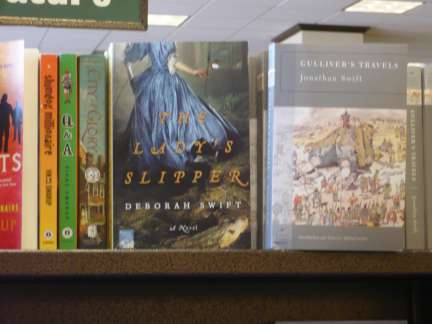
Here is the US edition of the book, on sale next to Gulliver's Travels, sadly I am no relation to the famous Jonathan Swift.


Research and Historical Fiction 
 Many people have asked me about how I do my research and how much time it takes to write a historical novel. So in this post I will take a little about my process, and also tell you about some of the some of the books I found invaluable in my research for The Lady’s Slipper.

My approach was not to try to know everything, but to read some general books on the 17th Century to get a broad picture, and then to start to write the book, filling in the gaps in my knowledge later. I keep a large notebook which is full of questions, for example, “How much was a loaf of bread in 1660?” “In a small village would there have been a bakery, or did people bake at home?” “What sort of bread? Millet? Wheat? Rye?” The answer to the last question was that in Westmorland where the book is set bread was called “clapbread” and was a flat cake made of oats, and it would keep for nearly a month! They had special oak cupboards built into their cottages to keep it in over winter –  frequently the answers are not what you expect but even more interesting. 

So after getting the overview I write my story, but I am left with a bulging and quite daunting note book full of questions. I take a deep breath, start at the beginning again and find out the answers and facts and decide if they help or hinder the story. I think I enjoy the “detective” element of finding out the answers to obscure questions! I read a lot of non-fiction and I am eternally grateful to the “real” historians who supply me with the answers. Books such as The Weaker Vessel by Antonia Fraser which gives a record of women’s lives in the Civil War in their own voices, and Restoration London by Liza Picard which was indispensable for information about daily life. Another favourite was Birth, Marriage and Death by David Cressy, which was always on my desk.


When I began writing The Lady’s Slipper I had no idea that my characters were going to end up on a ship, and of course I knew nothing at all about sailing ships, not even modern ones. No matter how many books I had read on the 17th century beforehand, it was unlikely I would have found out what I needed to know about Dutch Flute sailing ships without doing some very specific research. So I forced myself to read Patrick O’Brian’s books which are all set at sea, and what he doesn’t know about tall ships would probably fit on a postage stamp. They are the sort of historical fiction I would never normally pick up, but they are excellent. I also found out by emailing The Maritime Museum that the cow was stabled “aft”, and that foodstuffs were often sealed in dried mud to keep them fresh on board.
Wonderful Levens Hall, near where I live, on which I based Fisk Manor

To write about people’s homes I spent time at a number of old houses including Levens Hall, which helped me to create Fisk Manor, the home of Geoffrey Fisk in the novel. There is nothing like walking down a 17th century staircase and feeling the polished wooden banisters and seeing the light pour in through mullioned windows. At Swarthmoor Hall I sat and wrote a scene at a gnarled and polished oak table where George Fox the Quaker leader may have sat when he lived there with Margaret Fell. After such an immersion in the past it feels very strange then to get in my car and zoom away!

The botanical facts about the orchid I researched through interviewing members of the Cypripedium Committee, a sort of plant mafia set up to protect the Lady’s Slipper. They meet behind closed doors and the location of the last remaining plant in Britain is a closely guarded secret even today. The single-minded enthusiasm of these men, and their dedication to preserving the plant for future generations gave me confidence in my heroine, Alice Ibbetson’s obsession with it. But I also read novels such as The Orchid Thief and Tulip Fever, which treat similar themes. 

Being a costume designer I could not resist the Northampton Shoe Museum where there are many shoes on display. In The Lady’s Slipper Ella the maid is envious of her mistress’s slippers.Ella's story is told in The Gilded Lily, out in a few weeks time.

Often the research throws up new plotlines and then I will re-write scenes or chunks of the book to incorporate little-known or exciting research. I think to write historical fiction you have to enjoy this aspect of it because you are going to do an awful lot of it. When people ask me how long it takes to research the novel they are thinking in terms of a finite time, but actually I am researching all the time, my living room always has a pile of ten or twelve “current” books I am dipping into, not to mention photocopies and print-outs such as bits of the diaries of Pepys and George Fox and other helpful 17th century scribblers. Did I forget to mention the internet? The phone rings, and I half expect my husband to say, “Hang on, she’s googling.”

This post first appeared on Amy Bruno's site Passages to the Past. Thank you Amy. Amy is organising 
my Blog Tour for The Gilded Lily, find out more at http://www.hfvirtualbooktours.com/

Look to the right to grab the button for this blog hop!
<!-- end LinkyTools script --

Sunday, 17 June 2012

Writing Historical Fiction - The Power of Then and the Power of Now


All historical fiction readers understand the power of Then. The lure of an unknown time or place which is only unknown because it happened to take place before we were born. Unlike fantasy, this is an unfamiliar world which, if we took them back far enough, our own flesh and blood ancestors would be able to recognise. The small everyday details are what represent for me the power of Then. The type of flax cloth used for washing your face, the way a fire was lit with a tinder-box, the particular smell of tallow candles, the tickle of a feather in your hat. As a novelist my job is to place the reader in that time, but only recently have I come to understand that the job of doing that is really all about the power of Now.

The best plots spring straight out of Character. In other words, if my characters have strong enough motivations, particularly opposing ones, then the plot will naturally arise from their thoughts and actions. My most convincing writing arises when I inhabit the character so well that I lose track of time and am fully in the Now with that person going about their daily life. When I am trying to force the character to conform to a plot idea, historical event or action, then the writing becomes harder and less natural. Much of it is about listening to the character's voice and letting them speak.

The British Library
For a historical novelist to find that voice might mean reading diaries of the time, listening to archive material or looking up dialect dictionaries - all things I did to try to find voices for my two country girls in The Gilded Lily. I also read plays by Aphra Behn and by Dryden. My previous characters had all been well-educated, spoke proper English and had broad philosophical and worldly horizons. Not so Ella and Sadie Appleby, my two working maids from a small isolated village in The Gilded Lily. Their vocabulary was of necessity smaller, many of their thoughts were conveyed by gestures - a shrug or a raise of the eyebrows. They had naive views about finding fame and fortune and their place in the world, but more complex views about justice and fairness and honesty.

And I wondered how this would change as they went on the run in the big city, whether they would learn new ways of speaking or  new ideas, or yearn for new horizons. And of course they do - the city moulds them into someone different, but not just the city, the London characters they meet; the wigmaker, the pawnbroker, the astrologer.


Of course I live in the twenty first century so after my research the voices I heard in my head were not pure 17th century, but unique voices, a blend of 17th and 21st century expression. It is odd, but once I can hear my characters speak, then the characters become flesh and blood. Them surprising me is all part of the Power of Now. This is probably one of the reasons why I enjoy writing my books from several different contrasting viewpoints. I spend time in the company of each character, walk a few miles (or chapters) in his or her shoes.


For The Gilded Lily that meant becoming so familiar with my 17th century map of London that I could literally walk the city streets and turn left and right from Sadie and Ella's lodgings to the Pelican Coffee shop where Jay Whitgift, the handsome, but deadly, rogue did his business. As I went I practised walking as they might walk, looked up at the landmarks on the way.

For me, a narrative structure arises from the choices of my characters not from my own choices. How can that be, when I am both creator and created? This is the mystery and excitement of writing for me - the discovery of a great adventure, or that moment when I come back to myself and read it back, and see that the character is alive there on the page.The Power of Then, and the Power of Now.


THE GILDED LILY
Blurb:
A novel of beauty and greed and surprising redemption, set in a London of atmospheric coffee houses, gilded mansions, and the shady pawnshops hidden from rich men’s view,

England, 1660. Ella Appleby believes she is destined for better things than slaving as a housemaid and dodging the blows of her violent father. When her employer dies suddenly, she seizes her chance - taking his valuables and fleeing the countryside with her sister for the golden prospects of London. But London may not be the promised land she expects. Work is hard to find, until Ella takes up with a dashing and dubious gentleman with ties to the London underworld. Meanwhile, her old employer's twin brother is in hot pursuit of the sisters, and soon a game of cat and mouse begins. As the net closes on the girls, danger looms from quite another unexpected horizon...

UK version out 13 Sept
US version out 27 Nov

Thursday, 17 November 2011

The Creation of a Master-piece - Guilds in England


From the 14th century right up until the 18th century in England, no master-craftsman could set up in a particular craft unless he became a member of its Guild.

So what were these Guilds that had such a stranglehold on craftsmanship and production?

The Guilds were controlled by a self-elected oligarchy, or confraternity of craftsmen, a system greased by bribery and favouritism.

Above, a bootmaker from Northampton shows his wares.


Guild Laws restricted a man to the manufacture of only one article, for example weavers were not allowed to dye their cloth, shoemakers were not permitted to mend shoes and bowyers could not make arrows for their bows, only the fletchers could do that. This was supposedly to protect each craftsman's job, but in practice led to much dispute and difficulty.

If you became a member of a Guild you would have to make your goods from specified materials, employ a specified number of apprentices, and sell at the Guild's fixed prices. If you failed to do this, or produced shoddy goods or work not approved by the Guild you would face penalties such as a fine, punishment in the pillory or imprisonment. Each Guild had a Court, and cases not satisfied in the Court would go before the Mayor who would arbitrate.

Only freemen of a particular town could join the Guild for their craft. Even if you had been a Guild member in another town, you still had to serve 5 years bound to a recognised master in the new town before you could prove yourself by making your "master-piece" and finally being admitted to join.

No one was allowed to sell their goods by candlelight, in case of passing off faulty workmanship under cover of darkness, and no work could be done after eight o'clock Saturday night until Monday morning, to respect the Sabbath.

Guilds were social as well as business institutions, and concerned themselves with the welfare of their workers and founded schools and alms-houses, even occasionally in some crafts supplying dowries for poorer women workers. Each Guild had its own Chaplain to conduct the services, and its own patron saint - St Anthony for grocers, St Patrick for saddlers, St Clement for tanners, St Stephen for weavers, and so forth.


Crafts were highly specialised, there were Guilds of longbow-string makers, salters, horners, patten makers, quilters and pin makers. Above you can see the Guild of Painters, of 1695. As you can see they are all dressed alike. Each Guild had its own costume, with variations for the different ranks. Apprentices wore blue cloaks in the winter and blue gowns in the summer. Nobody was allowed to wear cloaks below calf-length until they reached old age.
Many of England's finest buildings are the Guild Halls quite a few of which survive. The one pictured is Leicester's Guild Hall, a fine Elizabethan example.


"a haberdasher and a carpenter,
A webber, dyer and a papicer
Were with us eke, clothed in a livery
Of a solemn and great fraternity.
Full fresh and new their gear apyked was,
Their knives were ychaped not with brass,
but all with silver wrought full clean and weel.Their girdles and their puches every deal.
Well seemed each of them a fair burgess
To sitten in a Guild Hall on a dais"
Chaucer

Thursday, 2 June 2011

A Poisonous Garden

Whilst researching The Lady's Slipper I had to look into the effects of orchid root when it was ground up and taken as medicine. This involved finding out what kind of solvents might have been used to keep the root in suspension, once it was pulverized, and then what sort of quantities might cause hallucinations or nausea if taken orally. Needless to say, I did not try it myself, but relied on various historical reports and on the medical journals of the time!

Weights and measures were different in the 17th century, for example barley could be sold in pecks or in pints, and with small quantities such as medicines the basis for an apothecary was the system of the "grain". Weights were as follows:
One grain
One scruple = 20 grains
One drachm = 60 grains
One ounce = 480 grains
One pound = 12 ounces = 5760 grains
The only liquid measure in the Apothecary System was the liquid grain which was the volume of water weighing one grain, but this was not introduced until much later in 1885. (The picture above shows a 17th century set of weights.)
As a novelist, although I might have wanted to use the term "scruple" for Geofrey Fisk to measure his medicine I chose not to, as "scruple" in modern usage has quite a different meaning.

Until the 20th century lady's slipper root - sometimes called moccasin flower - was used by Native Americans as a nervine and sedative, but modern pharmaceuticals with less side effects have replaced it today.

In Britain there have only been three deaths over the last fifty years that might have been caused by plants, but that does not mean you should not be wary of certain flowers and berries.

Hemlock is the most notorious killer, which causes paralysis of the lungs if ingested. In the Middle Ages a general anaesthetic was made out of hemlock, henbane and opium and used before surgery, particularly during amputations. Hardly surprisingly this kept the patient in a deep sleep for several days until the antidote was administered - vinegar!

Another poison, Deadly Nightshade or Belladonna, was used in the 17th century to increase a woman's attractiveness by dilating the pupils. It was dropped into the eyes, and caused blurred vision. If you were to drink it however you would suffer from convulsions, coma and finally death.

More information about poisonous plants from www.thepoisongarden.co.uk
fascinating talks about Garden lore
http://www.capabilitybowes.com/