


This Giveaway has now ended and the winner is Susan Heim! Congratulations to Susan, and thank you to everyone who commented, or followed me on Facebook or the blog.
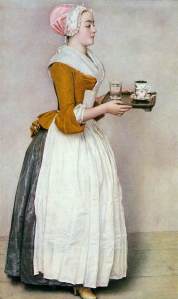 The Chocolate Girl
by Jean Etienne Liotard
I first wrote about this painting back in December last year in a post about maidservants, but I thought it was a great story for a Valentine's week post and worth highlighting again. I don't know if there is a novel based on this Cinderella-like tale, but it might make a good one. (No plans for it myself!)
The story behind the commissioning of this painting is a great romantic myth. The girl in the portrait, Anna Baltauf, worked as a maidservant in one of the Viennese chocolate shops which had become hugely popular during the 17th and18th centuries. She had little chance of good marriage as her father was too poor to give her a good dowry, however in the summer of 1745, a young Austrian nobleman - Prince Dietrichstein - came into the shop. He fell in love with the Chocolate Girl and asked her to marry him, despite objections from his family As a wedding present to his 'chocolate girl' he commissioned this portrait of his wife wearing the maid’s costume she was wearing when he first set eyes on her. Is this true? I guess we'll never really know.
Ella Appleby from my book The Gilded Lily would have loved this story. It was what she dreamed about for herself, that a prince might come and rescue her from her humdrum life. Sadie, her sister, would have gently told her to stop dreaming and to deliver the tray to the customer before the chocolate went cold.
More information about the story can be found here
 The painting itself, formerly in Dresden, survived World War II and Allied bombs by being kept in a damp cellar in Konigstein Fortress and brought back to Dresden after the Germans retreated from advancing Russian troops. Fortunately it seems none the worse, and is a wonderful portrait of costume and detail from the mid 18th century.
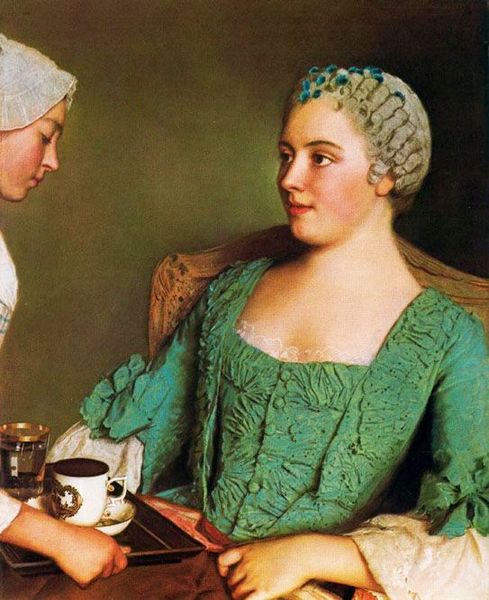
The same girl can be seen in one of Liotard's other works, 'The Breakfast.'
I am offering two copies of THE GILDED LILY - one for the Hearts through History Blog Hop, and one for the League of British Artists Valentine Giveaway. (Click to take you there)
Both are International - wherever Book Depository delivers.
Please comment below to enter the Hearts Through History Giveaway and leave an email address. Two extra entries for following my blog, one extra entry if you 'like' my facebook page http://www.facebook.com/TheGildedLilyBook
Hop Participants - Hearts Through History
Please comment below to enter the Hearts Through History Giveaway and leave an email address. Two extra entries for following my blog, one extra entry if you 'like' my facebook page http://www.facebook.com/TheGildedLilyBook
Hop Participants - Hearts Through History
Random Bits of Fascination (Maria Grace)
Pillings Writing Corner (David Pilling)
Sally Smith O’Rourke
Darcyholic Diversions (Barbara Tiller Cole)
Faith, Hope and Cherry Tea
Rosanne Lortz
Sharon Lathan
Debra Brown
Heyerwood (Lauren Gilbert)
Regina Jeffers
Ginger Myrick
Anna Belfrage
Fall in love with history (Grace Elliot)
Nancy Bilyeau
Wendy Dunn
E.M. Powell
Georgie Lee
The Riddle of Writing (Deborah Swift)
Outtakes from a Historical Novelist (Kim Rendfeld)
The heart of romance (Sherry Gloag)
A day in the life of patootie (Lori Crane)
Karen Aminadra
Dunhaven Place (Heidi Ashworth)
Stephanie Renee dos Santos
Pillings Writing Corner (David Pilling)
Sally Smith O’Rourke
Darcyholic Diversions (Barbara Tiller Cole)
Faith, Hope and Cherry Tea
Rosanne Lortz
Sharon Lathan
Debra Brown
Heyerwood (Lauren Gilbert)
Regina Jeffers
Ginger Myrick
Anna Belfrage
Fall in love with history (Grace Elliot)
Nancy Bilyeau
Wendy Dunn
E.M. Powell
Georgie Lee
The Riddle of Writing (Deborah Swift)
Outtakes from a Historical Novelist (Kim Rendfeld)
The heart of romance (Sherry Gloag)
A day in the life of patootie (Lori Crane)
Karen Aminadra
Dunhaven Place (Heidi Ashworth)
Stephanie Renee dos Santos
Good luck everyone!


